The World's First Adaptive Patient Continuity Infrastructure™
Automatically adapts communication to how each patient naturally communicates, engages, and makes decisions biologically — helping practices improve continuity, reduce administrative burden, support reimbursement activities, and recover revenue that quietly slips away between visits.
Patients feel understood.
Staff feel supported.
Leadership gains visibility.
The practice retains more patients, recovers more revenue, and increases its revenue potential.
Most practices know when a patient disappears.
Few know why.
Fewer still know it before it happens.
Patient Continuity Intelligence™ helps practices — automatically —
Identify engagement risks, uncover behavioral barriers, support routine continuity
workflows,
and give staff one clear place to see what needs attention next.
This is not another reminder tool, chatbot, or disconnected automation.
It is HIPAA-compliant patient continuity infrastructure built to improve communication, visibility, operational recovery, and follow-through — while keeping the practice fully in control.
Built by the leader who scaled a failing healthcare startup
from near $0 to $100M+ ARR in just 3 years —
rapidly transforming the organization from struggling, to becoming the
Inc. 5000 #1 Fastest-Growing Healthcare Company in America.
Healthcare experience translated into adaptive patient continuity infrastructure.
Patients rarely disappear
all at once.
They drift away
one missed touch at a time.
The appointment gets missed.
The follow-up gets delayed.
The home care plan gets ignored.
The patient stops responding.
The staff starts chasing.
And by the time the practice realizes continuity has broken, the patient may already be disengaged — along with the revenue, reimbursement support activity, and treatment progress tied to that relationship.
Continuity windows close quietly
Patient engagement often weakens between visits. If every touchpoint depends on staff memory, manual follow-up, and perfect timing, patients can drift before anyone notices.
Staff carry too much repetitive continuity work
Calls, texts, emails, reminders, reactivation, documentation, task tracking, and patient questions pile up until talented people spend half the day doing work that should have been automatic.
Most systems never discover the real barrier
Static automations can ask if something happened. Patient Continuity Intelligence™ helps uncover why it did not happen — scheduling friction, uncertainty, motivation decline, transportation issues, financial stress, pain flare-ups, or simple communication mismatch.
is still how many practices manage patient continuity, engagement tracking, documentation visibility, and follow-up after the visit ends.
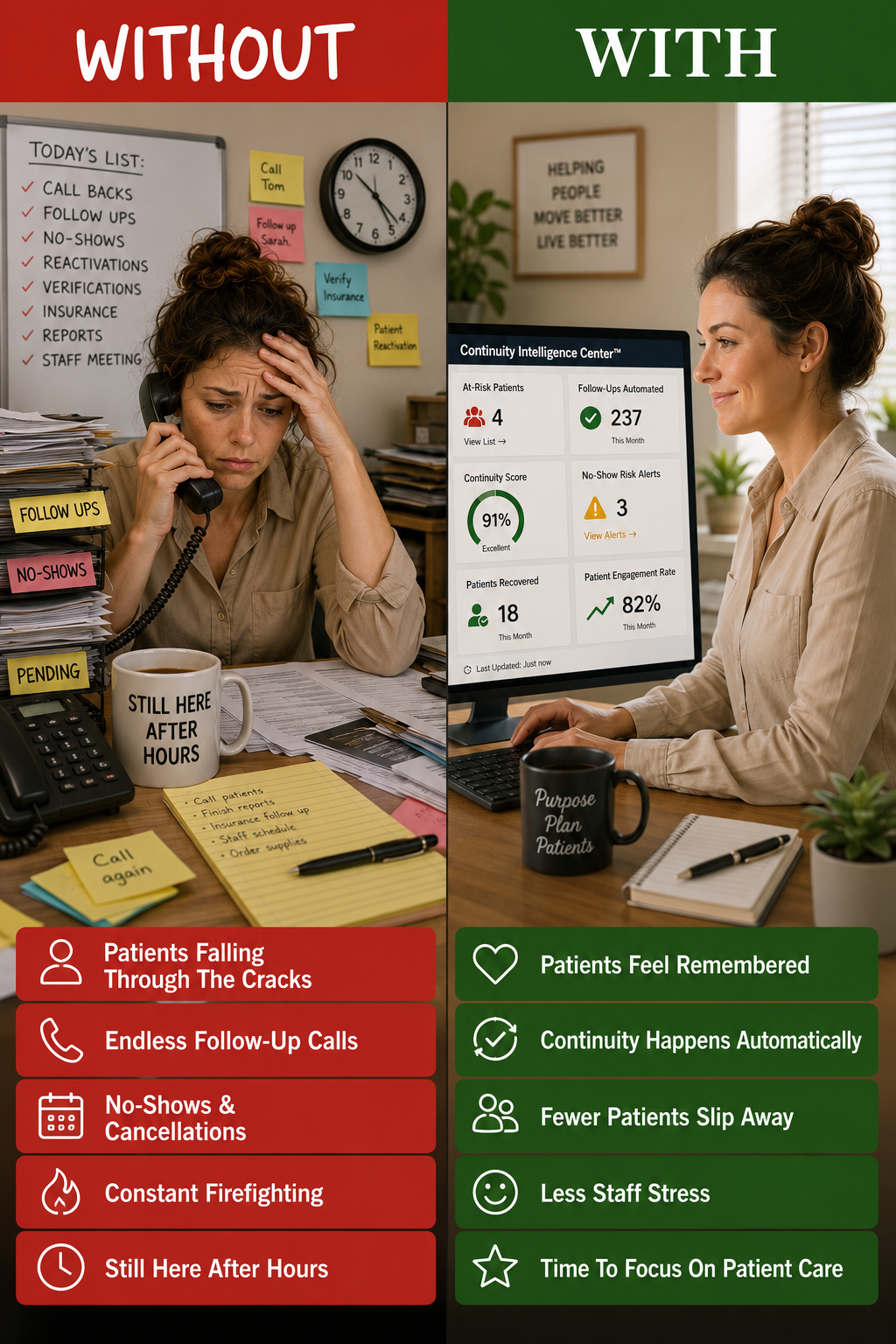
Imagine your day before Patient Continuity Intelligence™ and after.
Most healthcare technology focuses on tasks.
Patient Continuity Intelligence™ focuses on behavior.
Most patient communication systems
work like a toaster.
Send message.
Wait.
Send message.
Wait.
Send message.
Hope.
Congratulations.
You built a toaster.
The patient changes.
The situation changes.
The barrier changes.
But the communication stays exactly the same.
Patient Continuity Intelligence™ was designed differently. It adapts communication based on how each patient naturally communicates, engages, responds, and makes decisions biologically.
Static Systems Send Messages
Traditional reminders and generic automations can send texts, emails, and notifications. That does not mean the communication is relevant, persuasive, or aligned with the patient.
Adaptive Systems Create Engagement
Patient Continuity Intelligence™ adjusts language, cadence, density, tone, channel preference, and follow-up approach to better match the patient’s communication profile.
Engagement Protects Continuity
When communication feels more natural, patients are more likely to respond, reveal barriers, stay connected, and continue moving through the care journey.
Built on doctrine.
Not trends.
Patient Continuity Intelligence™ was engineered around the principles of The SDCC Way™ — Subconscious-Driven, Conscious Closing — a biological influence and leadership methodology built from more than two decades in healthcare leadership, multi-specialty operations, entrepreneurship, behavioral influence, decision architecture, and real-world operator performance.
The methodology is outlined throughout the Convert Clients™ Book Series, a body of work built from lessons learned influencing more than $1B in decisions and outcomes across healthcare and beyond.
Forged inside one of the most competitive and heavily regulated industries in the world — laboratory diagnostics — then refined through building, training, and leading high-performing, award-winning teams.
Then we taught it to a machine.
Why This Matters
Automation determines when communication happens.
Behavioral Intelligence helps determine how communication should happen.
One sends messages.
The other helps create engagement.
That is the difference between a reminder system and adaptive patient continuity infrastructure.
More than 100 proprietary
communication and decision signals.
Patient Continuity Intelligence™ uses SDCC-Trained Intelligence to evaluate communication, engagement, and behavioral signals during patient interactions.
Patient Communication Preference Profile™
The system builds a non-invasive profile of how each patient appears to prefer communication, information, pace, format, and decision support.
Adaptive Communication Routing
Patients can be routed toward the communication path that best aligns with how they are most likely to engage — SMS, email, voice, or blended outreach.
Aida™ Behavioral Intelligence Layer
Aida™ adapts copy, word usage, style, pace, cadence, message density, tone, and follow-up structure to meet patients where they are.
Most systems force
patients into one communication process.
Patient Continuity Intelligence™ adapts
the process to the patient.
Every patient wants
to feel remembered.
Most automated systems treat every interaction like the first conversation.
Patient Continuity Intelligence™ uses a proprietary Patient Memory Layer™ to preserve context between interactions, helping communication feel more relevant, more personal, and more natural over time.
The experience shifts from static automation to something closer to a true wellness companion supporting the patient journey.
The system can maintain visibility into:
- Previous conversations and patient concerns
- Communication preferences and channel response patterns
- Engagement history and follow-up activity
- Continuity challenges and behavioral barriers
- Missed appointment reasons and participation friction
- Patient-reported obstacles such as time, fear, cost, motivation, transportation, or confusion
- Interaction summaries that help staff re-enter the conversation with context
Isn’t this already in your
practice software?
Most practices already have Practice Management Software, Electronic Health Record systems, Chiropractic Management Software, scheduling tools, patient portals, and reminder platforms.
The problem is not a lack of software.
The problem is a lack of behavioral visibility.
Most systems automate messages.
Patient Continuity Intelligence™ automates continuity.
The difference becomes obvious when you compare what practices actually need to reduce workload, protect continuity, and understand patient disengagement.
One place to see what needs attention.
Before continuity breaks.
Imagine arriving at work tomorrow morning and opening one continuity infrastructure instead of juggling disconnected systems, spreadsheets, task lists, call logs, messages, and scattered patient notes.
Inside the Continuity Intelligence Center™
You immediately see which patients are at risk for disengagement, which continuity activities have already been completed automatically, which behavioral barriers have been identified, and where your team should focus next.
Instead of spending the day dialing, texting, checking, documenting, and chasing, your team performs fewer but more precise interventions.
Before making contact, staff can view the patient conversation thread with one click — what was said, when they responded, which channel they prefer, what barriers surfaced, and what the system has already done.
The result is simple:
less chaos, more clarity, better continuity, and more time for work that actually requires human judgment.
Continuity Center Views
- Patients requiring attention
- At-risk engagement indicators
- Communication history across SMS, email, and voice
- Continuity activity and follow-up status
- Behavioral barrier indicators
- Patient communication preference profiles
- Operational recovery metrics
- Reimbursement-support activity visibility
- Practice intelligence reporting
Make the savings visible.
Make the workload real.
Practices do not just need automation. They need to see what the automation is recovering: staff hours, avoided interruptions, completed continuity activities, and patients surfaced before the relationship breaks.
For the first time, continuity improvements become visible.
Recovered time is only valuable when leadership can actually see it.
Built to support the continuity work
practices already know they need.
Patient Continuity Intelligence™ is designed to help practices organize, monitor, document, and maintain communication and continuity-related activities commonly associated with managed care, wellness, and care management programs.
Communication Activity
SMS, email, and voice interactions can be captured, summarized, and reviewed so the practice has stronger visibility into patient engagement activity.
Continuity Tracking
Follow-up attempts, patient responses, engagement barriers, and open continuity needs can be organized in one centralized environment.
Documentation Support
The system helps create a transparent interaction history that can support internal review, workflow oversight, and continuity-related documentation processes.
Designed to support continuity activities commonly associated with programs such as CCM, PCM, RPM, and RTM — without replacing the practice’s responsibility for clinical decisions, documentation requirements, billing compliance, or regulatory obligations.
The question is not whether
these activities matter.
The question is how much time, energy, capacity, and revenue your practice is losing when they are performed manually, inconsistently, or across disconnected systems.
Patient continuity becomes easier
when the path is visible.
The system helps practices capture patient activity, recognize communication signals, adapt the engagement path, support routine continuity workflows, and surface the patients who need attention most.
Patient Activity
Communication, follow-up, appointment activity, interaction history, and continuity-related signals enter the system.
Communication Preference
Decision and communication signals help create a patient engagement profile without requiring invasive data collection.
Engagement Path
Aida™ adapts language, cadence, tone, channel, and message density to better match the patient.
Continuity Risks
The system helps identify disengagement patterns, barriers, and patients requiring attention.
Practice Focus
Staff can focus on fewer, higher-value interventions instead of spending the day chasing everyone.
Included With
Patient Continuity Intelligence™
A healthcare-specific deployment of ExecHero™ Decision Performance Infrastructure™ focused on patient continuity, engagement visibility, operational recovery, and adaptive communication.
Continuity Intelligence Center™
Centralized visibility into patient continuity activity, engagement status, communication history, operational recovery, and behavioral intelligence insights.
Behavioral Intelligence Engine™
SDCC-trained infrastructure designed to identify continuity signals, engagement patterns, decision indicators, and potential barriers impacting participation.
Automated Continuity Workflows™
Support routine follow-up, reminders, check-ins, patient communication, reactivation, and continuity-related engagement activity.
Patient Communication Hub™
Centralized communication infrastructure supporting SMS, email, and voice interactions across patient touchpoints.
Continuity Dashboards™
Track engagement trends, continuity activity, communication metrics, behavioral insights, operational recovery, and patient interaction history.
Behavioral Barrier Monitoring™
Identify patient-reported obstacles such as scheduling conflicts, motivation decline, cost concerns, transportation issues, uncertainty, or adherence friction.
Patient Memory Layer™
Preserve context between interactions so communication feels more relevant, personal, and continuous over time.
Practice Intelligence Reporting™
Access continuity-focused reporting designed to help practices understand engagement patterns, operational opportunities, and workflow friction.
Reimbursement Support Visibility™
Organize communication activity, interaction history, continuity signals, and workflow visibility commonly needed to support care-management processes.
Recover time, visibility, and continuity
automatically.
Recover Lost Revenue
Help reduce the revenue leakage that occurs when patients disappear, miss visits, fail to continue care, or require more follow-up than staff can consistently provide.
Reduce Administrative Burden
Automate routine communication, reminders, follow-up workflows, check-ins, and continuity-related interactions that often consume valuable staff time.
Improve Patient Continuity
Help maintain stronger patient engagement between visits and reduce the number of patients who unintentionally fall through the cracks.
Support Reimbursement Activities
Improve visibility into communication, engagement, documentation support, and continuity-related activity commonly associated with managed care and wellness programs.
Improve Staff Experience
Let trained people spend less time chasing, documenting, and searching — and more time on patient care, judgment, problem-solving, and higher-value work.
Strengthen Patient Experience
Create a more responsive, personalized, and adaptive communication experience that helps patients feel remembered, understood, and supported.
Designed for practices where continuity,
communication, and follow-through matter.
Patient Continuity Intelligence™ is built for healthcare and wellness organizations seeking to improve operational visibility, reduce repetitive staff burden, support patient engagement, and improve continuity between visits.
Chiropractic Practices
Support care plan continuity, missed visit recovery, reactivation, and ongoing patient engagement.
Primary Care Practices
Strengthen patient communication, follow-up visibility, chronic care engagement, and continuity between visits.
Walk-In Clinics
Improve post-visit follow-up, reactivation, patient communication, and visibility after the encounter ends.
Osteopathic Medicine
Support whole-person continuity, patient engagement, follow-through, and ongoing care relationship visibility.
Physical Therapy
Improve follow-through, appointment continuity, home exercise engagement, and communication between visits.
Pain Management
Maintain better visibility across patient communication, follow-up needs, adherence barriers, and continuity activity.
Naturopathic Practices
Support longer wellness journeys with adaptive communication, patient memory, recurring engagement, and continuity visibility.
Wellness Clinics
Support recurring engagement, patient check-ins, reactivation, communication, and relationship continuity.
Functional Medicine
Help practices support longer patient journeys with stronger communication, memory, and continuity visibility.
Concierge Medicine
Improve patient experience, communication visibility, and continuity support across high-touch relationships.
Integrative Health
Support ongoing engagement where patient participation and communication are central to the experience.
Healthcare Groups
Increase visibility across patients, teams, communication activity, continuity workflows, and operational recovery.
Built by the leader who scaled a failing healthcare startup from near $0 to over $100M ARR — in just 3 years.
Patient Continuity Intelligence™ was created by Rob Mitchell, the leader who transformed a failing healthcare startup into an Inc. 5000 #1 Fastest Growing Healthcare Company and the #4 Fastest Growing Company Overall in America. (25,485% growth just three years)
Under his leadership, the organization became the Inc. 5000 #1 Fastest Growing Healthcare Company in America and the #4 Fastest Growing Company Overall.
The system was built by someone who understands healthcare operations from the inside: staffing pressure, administrative burden, patient disengagement, continuity breakdowns, growth demands, reimbursement support requirements, and the daily reality of trying to do more with less.
This is not healthcare theory.
It is healthcare experience translated into infrastructure.
Why Practices Trust The Infrastructure
- Built by healthcare leadership
- Scaled from near $0 to $100M+ ARR
- Inc. 5000 #1 Fastest-Growing Healthcare Company in America
- Inc. 5000 #4 Fastest-Growing Company Overall in America
- $1B+ in influenced decisions and outcomes
- Creator of The SDCC Way™
- Author of the Convert Clients™ Book Series
- Led global healthcare teams of 600+ members
- Built from healthcare growth, operations, leadership, and behavioral influence experience
Fully Automated. Fully Transparent. ALWAYS Fully Under Your Control.
Automation should never remove visibility or control. Patient Continuity Intelligence™ was intentionally designed to increase both.
Visible
Read, review, and monitor patient communication activity, interaction summaries, continuity workflows, and engagement patterns.
Reviewable
View patient threads, outreach history, channel activity, behavioral signals, and continuity actions from inside the Continuity Intelligence Center™.
Intervenable
Your team remains in control. Step into the conversation, pause automation, redirect follow-up, or take over whenever human judgment is needed.
Automation should give your team leverage.
It should never turn patient communication into a black box.
The SDCC-Trained Intelligence Layer
Behind Patient Continuity Intelligence™
Aida™ is the adaptive intelligence layer inside Patient Continuity Intelligence™.
She helps manage patient communication, interpret engagement signals, identify behavioral barriers, support continuity workflows, and adapt follow-up based on how patients respond across SMS, email, and voice.
Unlike static automations that send the same message path to every patient, Aida™ uses SDCC-Trained Intelligence to adjust communication style, cadence, channel, message density, and follow-up approach as patient behavior becomes clearer.
The more Aida™ interacts with your practice environment, the more useful your continuity intelligence becomes.
What Aida™ Helps With
- Adaptive patient communication
- Continuity follow-up workflows
- Patient communication preference signals
- Behavioral barrier identification
- At-risk patient visibility
- Patient memory and interaction context
- SMS, email, and voice engagement support
- Operational recovery intelligence
Before we discuss PCI™, let’s first identify where patient continuity, staff capacity, and revenue may already be slipping away.
Most practices do not have a patient communication problem. They have a continuity problem. Patients miss visits, delay follow-up, ignore care plans, stop responding, or quietly drift away while staff are buried in repetitive outreach and manual tracking.
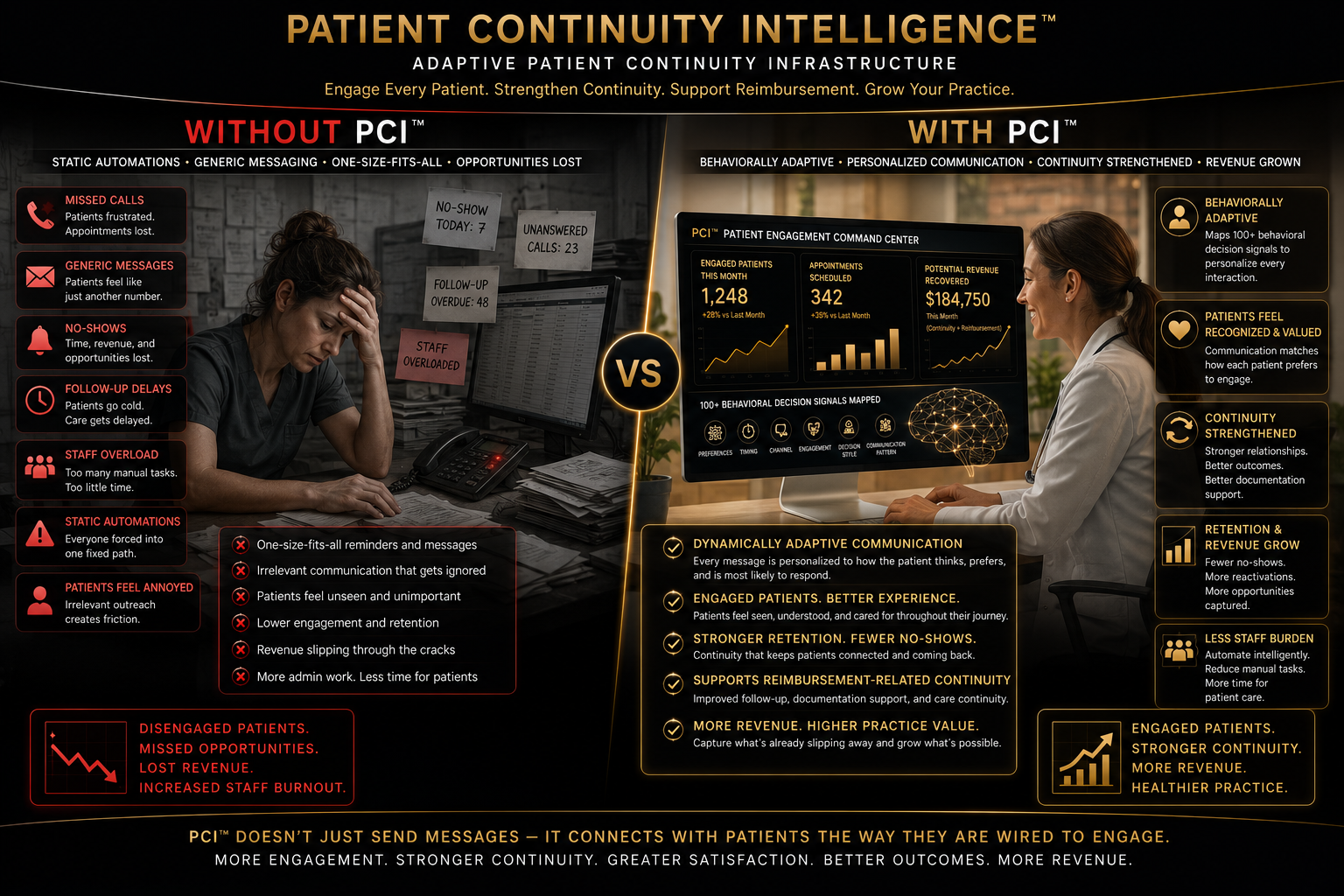
Patient Continuity Intelligence™ does not simply send reminders.
It helps communication adapt to how each patient naturally engages,
responds, and makes decisions — so patients feel recognized, staff
feel supported, and continuity becomes easier to protect.
Find The Continuity Leak
We look for where patients are falling through the cracks: missed visits, delayed follow-up, weak reactivation, ignored care plans, unanswered messages, and continuity workflows that depend too heavily on staff memory.
Recover Staff Capacity
We identify where your team is losing time to repetitive patient outreach, reminders, documentation support, call-backs, reactivation attempts, and manual continuity tracking.
Map The PCI Opportunity
We determine whether PCI™ can help improve patient engagement, reduce administrative burden, strengthen continuity visibility, support reimbursement-related workflows, and recover revenue potential.
Not sure where patient continuity is actually breaking?
Most practices feel the symptoms before they can see the source.
The missed follow-up. The no-show that never gets recovered. The patient who stops responding. The staff member chasing the same reminders again and again. The revenue that does not disappear all at once — it leaks out quietly between visits.
The PCI Assessment™ helps you identify where continuity, staff capacity, visibility, documentation readiness, and patient revenue potential may already be slipping.
In a few minutes, you will see where the practice may be leaking:
- Staff time trapped in repetitive continuity work
- Patients drifting before anyone notices
- Follow-up gaps hiding inside busy schedules
- Documentation and communication history scattered across systems
- At-risk patients not surfaced early enough
- Revenue potential tied to recovered capacity and better continuity
Book A PCI™ Strategic Assessment
This is not a generic software demo. It is a focused patient continuity assessment for serious practices that want to understand where patients are disengaging, where staff capacity is being consumed, and whether Patient Continuity Intelligence™ is the right infrastructure to help close the gap.
Reserved For Practices Serious About Continuity
- Practice owners who want stronger patient engagement
- Healthcare leaders dealing with no-shows, missed follow-up, or patient drop-off
- Teams spending too much time on repetitive patient outreach
- Practices needing better visibility into patient communication and continuity activity
- Organizations ready to move beyond static reminders and generic automation
This Is Not For Tire Kickers
- Practices not willing to improve continuity workflows
- Operators only looking for free consulting
- Teams that want generic reminders instead of adaptive patient engagement
- Organizations unwilling to create visibility around patient follow-through
- Practices not ready to invest in better patient continuity infrastructure
“The question is not whether patients are being contacted. The question is whether each patient is being communicated with in the way they are most likely to understand, trust, and respond.”
Every Deployment Is Custom
Patient Continuity Intelligence™ is deployed as a dedicated intelligence environment calibrated specifically to your practice, your workflows, your communication preferences, your continuity objectives, and the unique behaviors of your patient population.
Isolated Practice Intelligence
Unlike shared software platforms, each deployment is designed to help keep your data isolated, your intelligence specific to your organization, and your continuity infrastructure aligned to how your practice actually operates.
Calibrated To Your Patients
With every patient interaction, text message, email, phone conversation, outreach attempt, appointment outcome, engagement event, and continuity signal, Aida™ learns more about your practice and the people you serve.
Built To Improve Over Time
The more your practice uses the infrastructure, the more patient behavior, engagement patterns, communication preferences, and continuity risks become visible.
Aida™ Gets Smarter Over Time
Operational
Aida™ is calibrated, deployed, and ready to support continuity workflows.
Pattern Recognition
Aida™ begins identifying meaningful communication, engagement, and continuity patterns.
Intelligence Asset
Aida™ becomes a continuously improving continuity intelligence asset for your practice.
Capable of recognizing behavioral trends, identifying disengagement risks, supporting operational recovery efforts, and helping your team focus attention where it creates the greatest impact.
The result is not simply automation.
It is an adaptive, decision-led continuity infrastructure that learns, evolves, and self-optimizes with every patient interaction.
Healthcare has Electronic Health Records.
Healthcare has Practice Management Software.
Now healthcare has
Decision Performance Infrastructure™.
The next evolution in patient continuity, engagement intelligence,
operational recovery, and practice performance.
We Are ExecHero™.
Welcome To A New Age Of Patient Well-Care.
Where continuity is intelligent.
Engagement is adaptive.
Visibility is complete.
And better decisions happen naturally.
A continuity layer.
Not a clinical replacement.
Where Patient Continuity Intelligence™ Fits
Patient Continuity Intelligence™ is designed to support patient communication, continuity workflows, engagement initiatives, documentation visibility, operational recovery, and practice intelligence.
The infrastructure helps practices automate repetitive continuity activities, improve visibility between visits, and maintain patient engagement without increasing administrative burden.
Patient Continuity Intelligence™ does not provide medical advice, diagnosis, treatment recommendations, clinical decision-making, healthcare services, billing advice, or reimbursement guarantees.
Practices remain responsible for all clinical decisions, documentation requirements, billing decisions, regulatory compliance obligations, patient care activities, privacy practices, and use of the system in accordance with applicable laws, payer rules, and internal policies.
A few helpful answers.
Is this a medical tool?
No. Patient Continuity Intelligence™ supports communication, continuity workflows, engagement visibility, and operational awareness. It does not provide medical advice or clinical decision-making.
Does this replace our current systems?
No. It is designed as a continuity intelligence and engagement layer that supports existing practice workflows, communication processes, and patient engagement initiatives.
Is this the same as our reminder system?
No. Reminder systems typically send static messages. Patient Continuity Intelligence™ adapts communication based on patient behavior, communication patterns, response signals, and continuity risk.
Who should use it inside the practice?
Practice managers, patient coordinators, continuity champions, administrative teams, and leadership teams responsible for patient communication, engagement, follow-up, and operational visibility.
Can we see the conversations?
Yes. The system is designed for transparency. Practices can review communication history, patient threads, interaction summaries, and related continuity activity.
What is the main outcome?
Better patient continuity, stronger engagement visibility, reduced repetitive administrative burden, clearer reimbursement-support activity visibility, and more time for the work that requires your team’s talent.
Recover Continuity, Time, Visibility,
And Revenue — Automatically.
Discover how Patient Continuity Intelligence™ can help your practice strengthen patient engagement, reduce administrative burden, support continuity-related visibility, and give your team a clearer way to know what needs attention next.