The conversation is where momentum is won or lost.
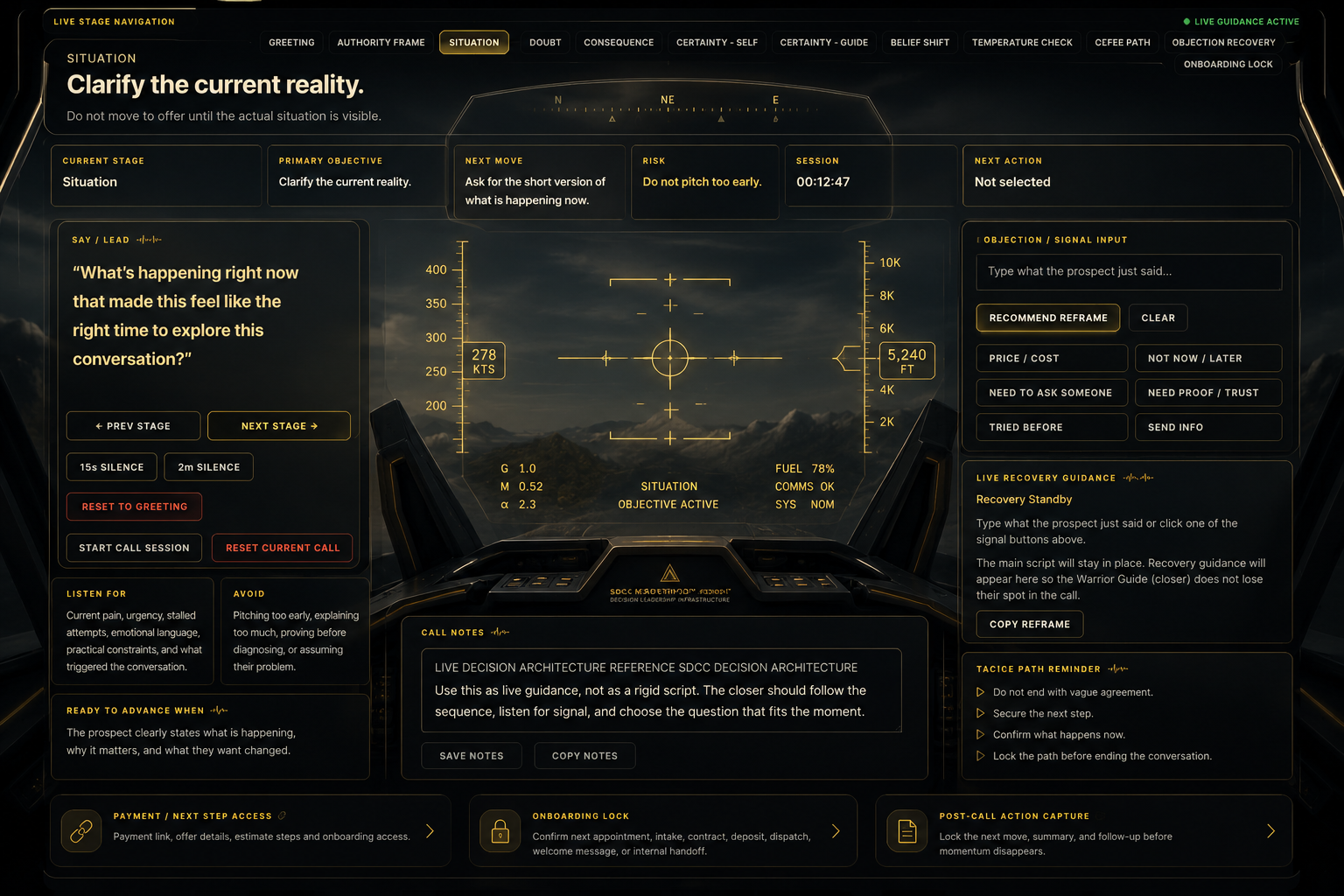
The Live Call HUD™ was engineered like a fighter jet cockpit for high-stakes conversations — keeping stage guidance, signal interpretation, objection recovery, silence discipline, payment access, call notes, tactical resources, and next-step control within one visual field.
This is not a script.
It is the Live Conversation Layer™ of ExecHero™ Decision Performance Infrastructure™ — built to reduce cognitive load, protect decision movement, and help operators perform at a higher level when the conversation matters most.
Most operators do not lose the call because they lack words.
They lose it because they lose the signal.
Under pressure, the mind narrows. Memory drops. Sequence breaks. The operator starts reacting to resistance instead of leading the decision.
The Live Call HUD™ keeps the decision path visible so the operator can stay present, listen clearly, and lead the next move.
Cognitive load increases under pressure
Scripts, notes, payment links, objections, and next steps scattered across tools create unnecessary drag.
Signals appear before they become objections
Hesitation, doubt, uncertainty, trust friction, and decision resistance often show up before the prospect says them directly.
Momentum dies when the next step is vague
The close is not complete until the path is locked, the next action is clear, and continuity is preserved.
Experience matters.
Instrumentation matters more under pressure.
Pilots do not remove instrumentation because they become experienced. They rely on instrumentation because the mission matters.
The Live Call HUD™ was engineered the same way.
Everything critical stays inside one decision environment so the operator does not hunt for what to say, where to go, what to send, or how to recover.
The HUD keeps the mission,
the conversation, and the next move visible.
The operator can maintain a natural eyeline while the critical instruments remain close — stage movement, recovery, notes, payment access, tactical resources, and close-path reminders.
Command Layer
Current stage, primary objective, next move, risk, session status, and next action remain visible so the operator always knows where they are.
Conversation Layer
Stage guidance, prompts, listening signals, recovery guidance, objection input, and close-path reminders stay in the operator’s field of view.
Tactical Reinforcement
Expandable SDCC question variants, quick probes, Neural Driver Lines, and Close Blades stay available when needed without cluttering the core call path.
When resistance appears,
the operator does not lose their place.
The prospect says things like “price,” “not now,” “need proof,” “send info,” “I need to ask someone,” and countless variations of the same underlying decision signals.
The operator can enter the signal directly or click one of the available signal buttons. The HUD interprets the likely meaning behind the signal, instantly recommends a recovery path, and keeps the main decision framework visible so the conversation stays on track.
Signal → Meaning → Reframe → Next Move
Detected: Timing / Not Now
Likely stage: Priority / Decision Readiness
Likely signal:
Timing may be protecting uncertainty.
What it probably means:
They may agree with the idea, but they have not made it important enough to act on yet.
Say this:
“That makes sense. Let me ask it this way — do you feel waiting will actually make this easier to solve, or does waiting mostly keep the same problem in place a little longer?”
Next move:
Clarify whether delay helps them or just postpones the decision.
Better decision control creates better outcomes.
When used during sales conversations, the Live Call HUD™ reduces cognitive load, protects sequence, and frees the closer to perform at a higher level.
Stronger conversations. Higher certainty. More consistent decision movement.
More wins. More often. At larger investment levels.
Regardless of niche, offer, industry, or price point.
Lock the next move
before momentum disappears.
The post-call layer lives one visual field below the cockpit. After the call, the operator scrolls down, captures the outcome, confirms the stage reached, chooses the next action, and generates the summary or follow-up draft with one click.
Call Summary
Capture what happened, what stage the decision reached, what objections surfaced, and what the team needs to remember.
Follow-Up Angle™
Use the current HUD stage to shape the next message so the decision movement continues instead of restarting cold.
One-Click Drafting
Generate summaries, next-step plans, and follow-up messages from call notes, then copy them into your CRM or ExecHeroGO™.
Every conversation can become training.
Call summaries and follow-up drafts created inside the Live Call HUD™ can be inserted into Digital ExecHero™ for deeper analysis.
Digital ExecHero™ can then help identify missed signals, decision-stage breakdowns, overlooked objections, and recurring patterns — so the operator sees what they missed and learns how to prevent missing it again.
Most people hear words.
SDCC™ teaches operators to read signals.
The words matter. But the words are rarely the entire conversation.
Certainty, hesitation, urgency, trust, resistance, authority, emotion, and decision readiness often appear before they are spoken directly.
Subconscious-Driven, Conscious Closing™
SDCC™ does not simply provide language. It provides the human decoder ring needed to interpret the conversation happening beneath the words.
Speak to the subconscious.
To drive conscious decisions.
Stop asking operators
to fly blind under pressure.
The Live Call HUD™ gives operators the instrumentation needed to guide decisions, protect momentum, reduce cognitive load, and lock the next move before the conversation disappears.