01
It changes where we look.
Instead of beginning with results that have already become history, it begins with the decisions still capable of changing the future.

Before revenue becomes visible, before culture takes shape, before strategy succeeds or fails, and before an organization becomes what it will become... decisions have already begun creating the outcome.
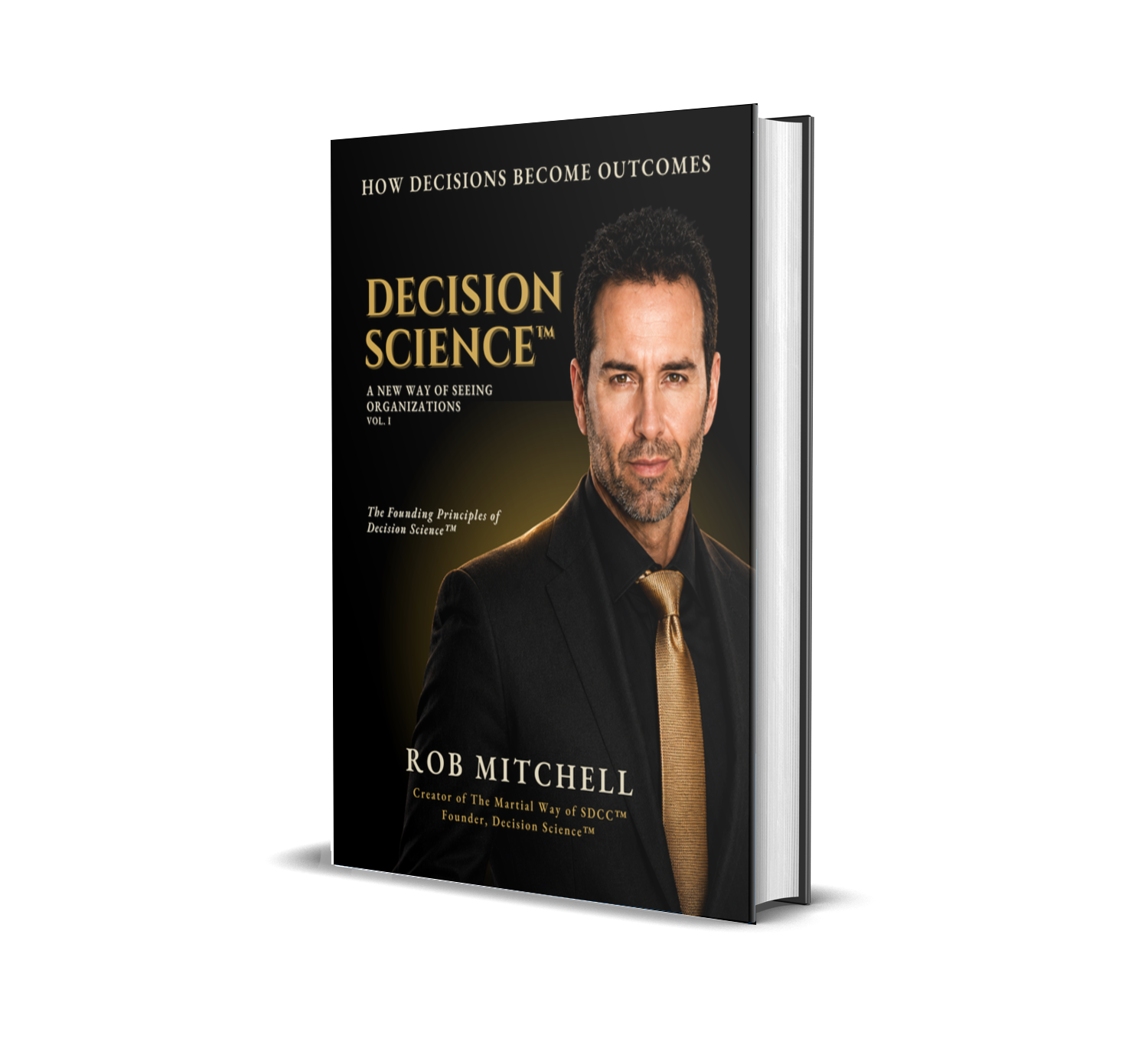
Decision Science™: A New Way of Seeing Organizations introduces the discipline devoted to understanding how decisions become outcomes across individuals, organizations, and society.
Volume I: How Decisions Become Outcomes
This is not another management book.
It is an invitation to look beneath strategies, structures, technologies, and performance metrics—into the invisible decisions from which they emerge.
Those decisions—made deliberately, habitually, visibly, and invisibly—accumulate across time until they become the results organizations eventually measure.
The visible organization is what everyone sees.
The invisible organization is what continually creates it.
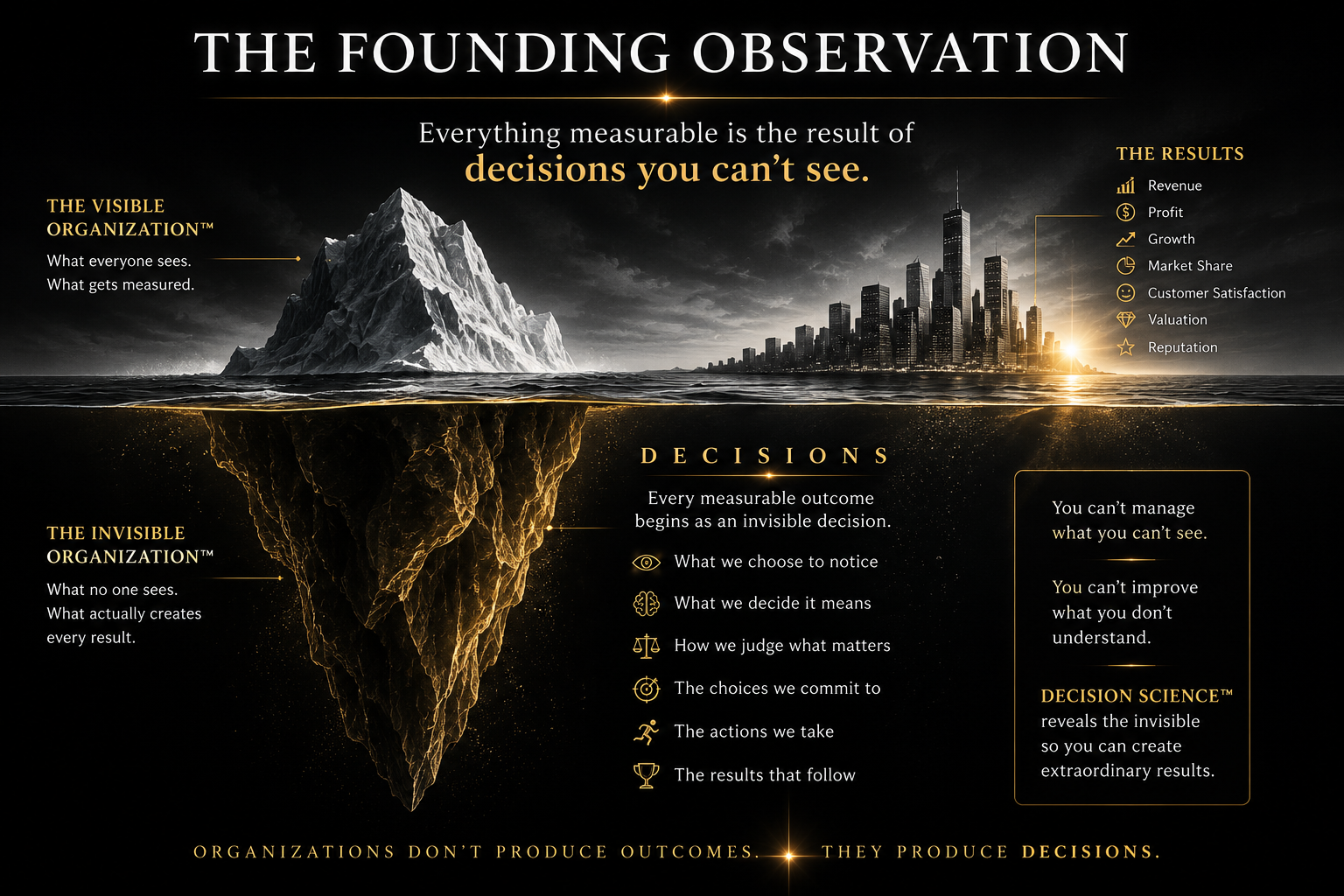
You cannot transform outcomes by changing only what is visible.
You must learn to observe, understand, and strengthen what is invisible.
Revenue. Profit. Growth. Retention. Culture. Innovation. Customer experience. Patient outcomes. Enterprise value.
Every one matters.
But they share one limitation:
they describe what has already happened.
By the time an outcome becomes visible, the decisions that created it have already been made.
It asks not only, “What happened?” but, “What decisions quietly created this?”
What decisions made these outcomes increasingly probable?
A discipline built around the universal principle that underlies every organization,
every strategy, and every measurable result:
every outcome begins with a decision.
Decision Science™ is the discipline devoted to understanding how decisions become observable outcomes across individuals, organizations, and society.
Instead of beginning with results that have already become history, it begins with the decisions still capable of changing the future.
Leadership, psychology, economics, management, technology, medicine, and systems thinking all encounter decisions. Decision Science studies them.
Clearer observation improves judgment. Better judgment improves decisions. Better decisions improve the probability of better outcomes.
What appears to be one choice,
is often the visible conclusion of
an invisible architecture that began much earlier.
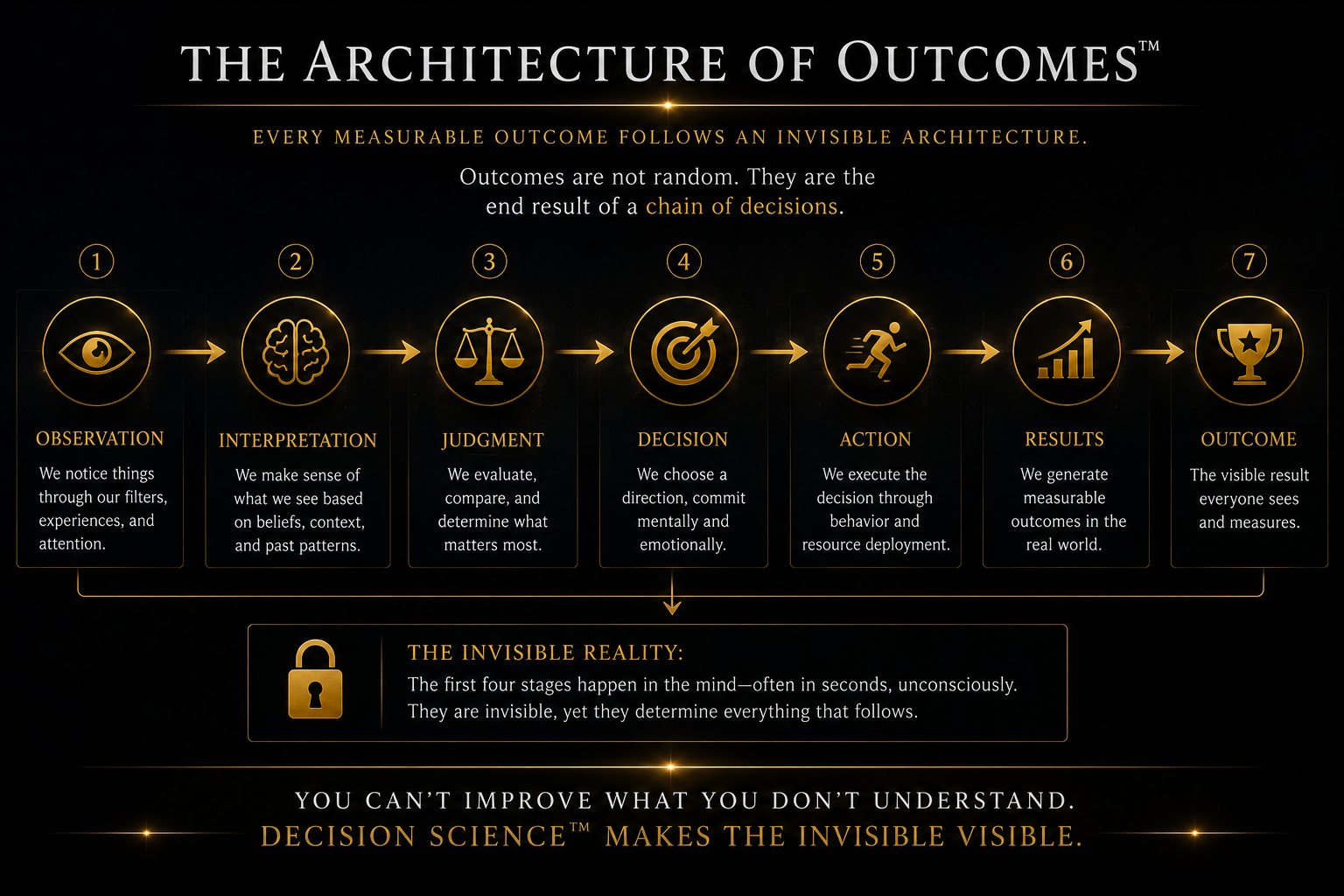
Organizations do not simply make decisions.
They accumulate decision architecture.
Over time, that architecture becomes one
of their greatest advantages—or one of their greatest limitations.
Most leaders work harder at reacting to outcomes.
Decision Science helps them work earlier…
where the outcome is still being created.
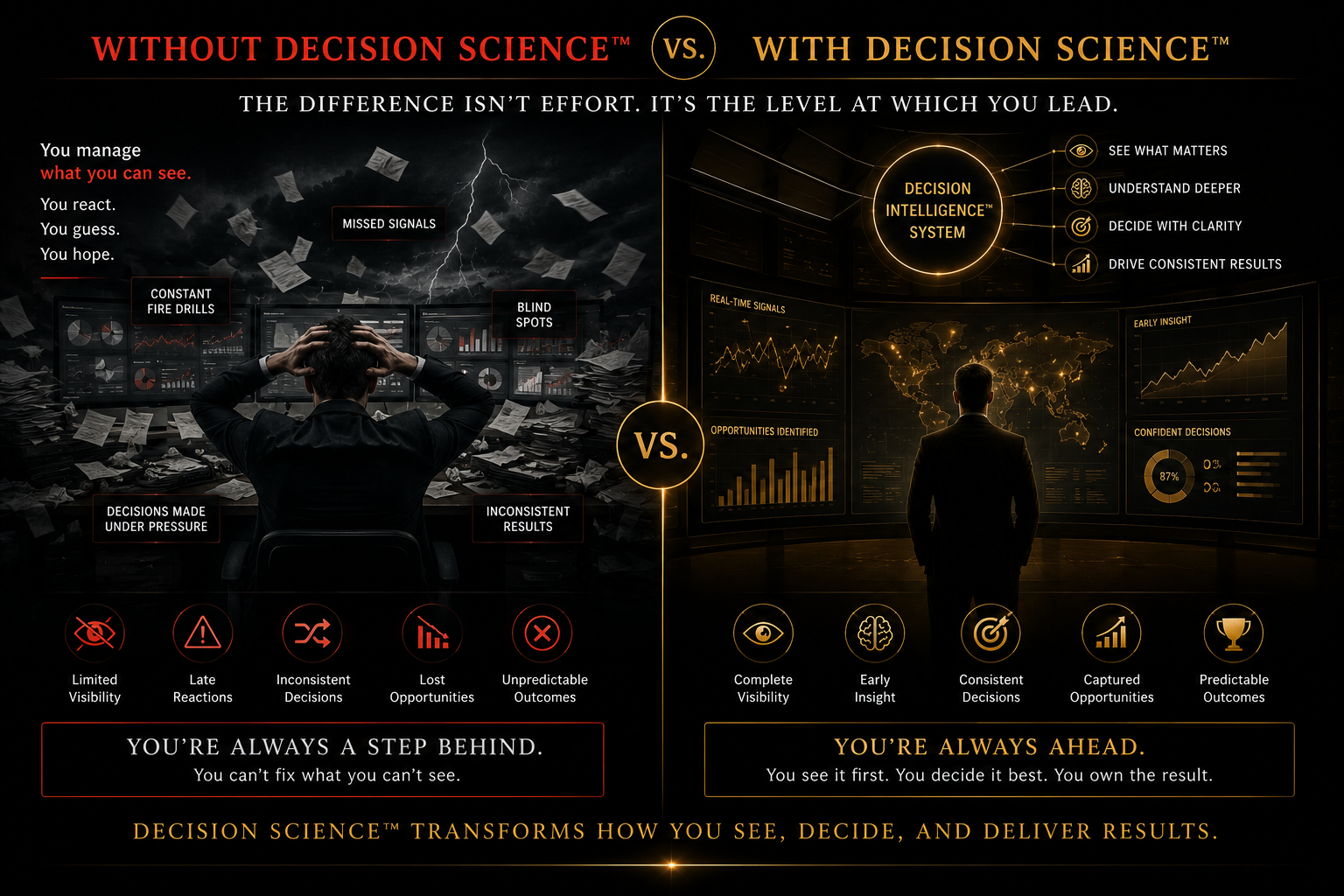
Managing symptoms keeps you behind the outcome.
Leading at the source allows you to:
SEE Earlier,
JUDGE More Clearly,
and
CREATE BETTER DECISIONS,
BEFORE Consequences Compound.
And once you begin to see the decisions beneath the outcomes, familiar meetings, policies, cultures, technologies, and performance problems may never appear quite the same again.
That is where the book begins.
The founding volume guides the reader through four evolutions—from observation to architecture, from architecture to judgment, and from judgment to the design of organizations capable of learning.
The founding volume is organized into four Books—not as separate publications, but as complete bodies of thought within the larger discipline of Decision Science™.
Learn to look beneath visible structures and measurable results.
Understand the systems through which judgment becomes performance.
Reframe leadership as responsibility for the conditions under which judgment is exercised.
Explore how decision systems can be designed to learn, strengthen, and improve over time.
Decision Science is the parent discipline.
Each branch is a lens focused on a different domain of decisions.
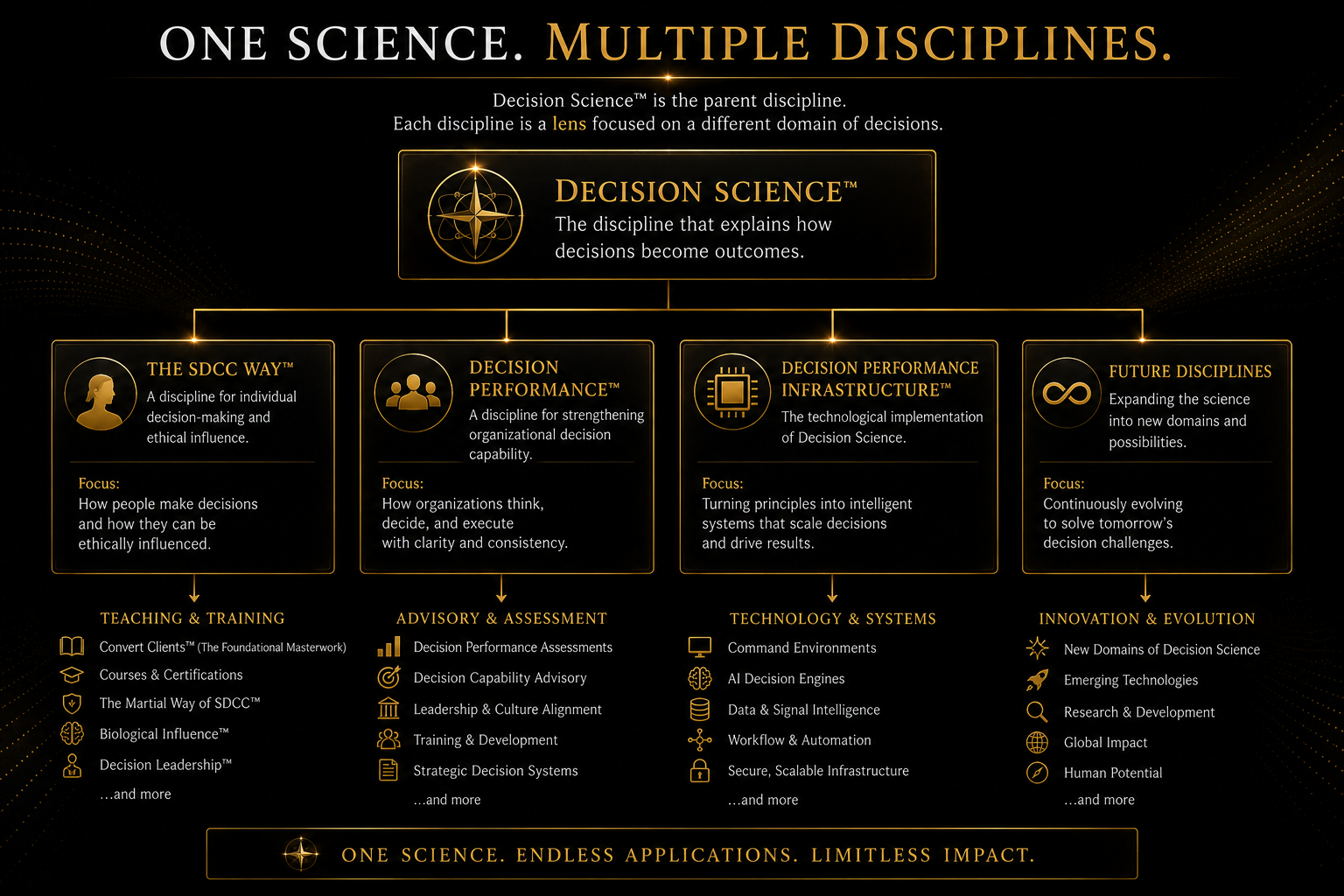
The SDCC Way™ is a distinct discipline devoted to individual decision-making, principled influence, identity, trust, and the biological forces that shape choice.
The SDCC Way™ approaches influence as leadership rather than pressure. It studies how biology, identity, emotion, trust, uncertainty, consequence, and conscious reasoning interact before a person commits to a decision.
From that discipline emerged Subconsciously-Driven, Conscious-Closing™, together with its principles of Biological Influence™ and Decision Leadership™.
Convert Clients™ is the book series through which the doctrine, philosophy, science, training, and application of The SDCC Way™ are transmitted.
Volume I establishes the Warrior’s Doctrine: the identity, philosophy, biological foundations, and principled code behind the discipline.
Volume II becomes the Dojo: the training, sequence, timing, presence, and embodied skill required to make the discipline instinctive.
Together, the books teach a commercially proven discipline that has influenced more than $1 billion in decisions across more than 100 industries.
Decision Science™ and The SDCC Way™ are separate disciplines within the same intellectual family: one studies decisions broadly; the other specializes in individual decisions and principled influence.
Decision Performance Infrastructure™, transforms principles into intelligent systems,
that help people and organizations to:
—OBSERVE More Clearly.
—DECIDE More Consistently.
—EXECUTE at Scale.
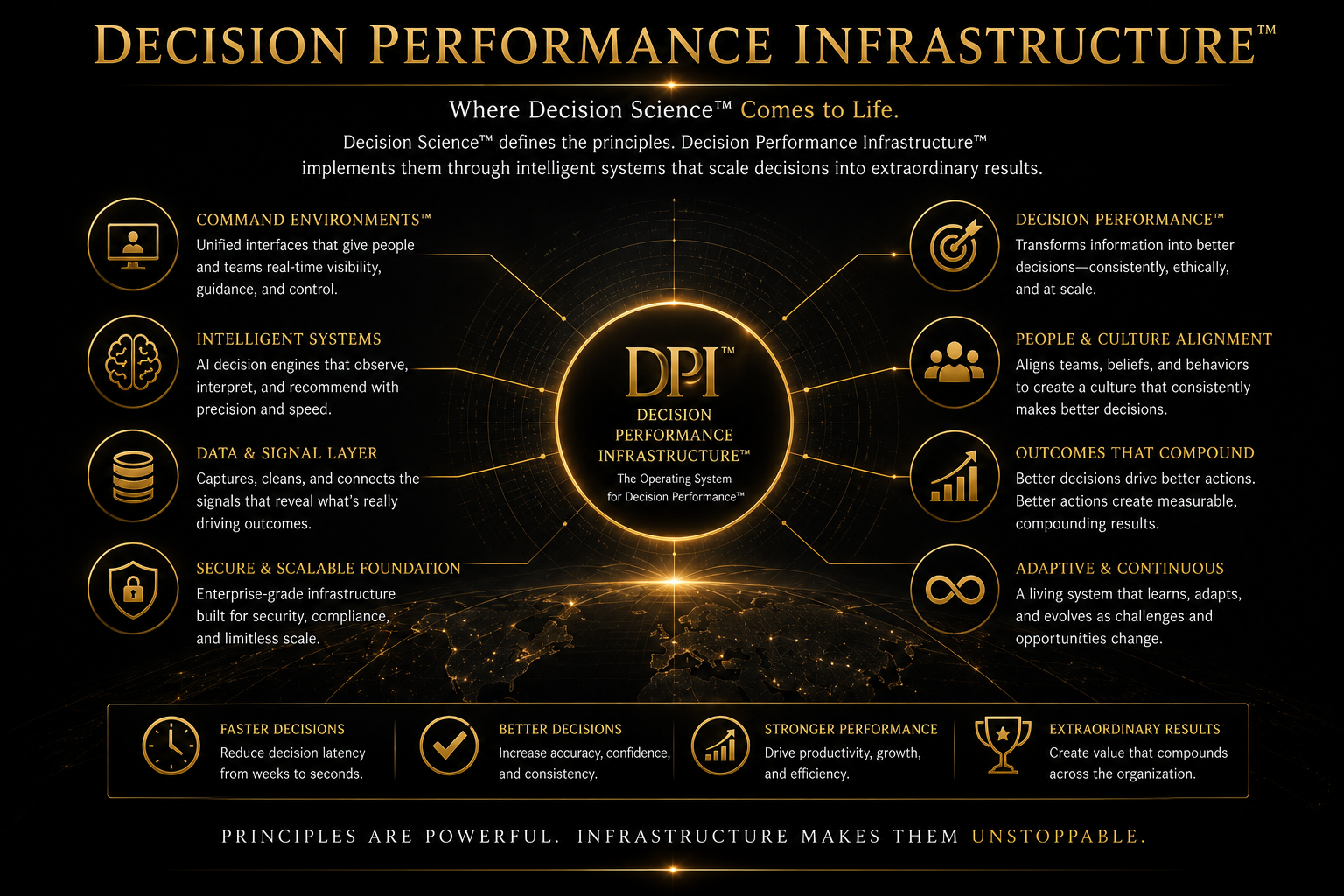
Decision Science defines the principles. Decision Performance Infrastructure™ implements them through intelligent systems, connected signals, secure infrastructure, and adaptive decision environments.
It offers a lens through which familiar organizations may begin
to appear unfamiliar…
yet at the same time, feel more clearly understood.
Not because every reader holds the same title:
but because every meaningful role eventually requires judgment.
Responsible for the conditions in which organizational judgment is formed and exercised.
Building companies whose futures emerge from thousands of compounding decisions.
Navigating uncertainty, complexity, transformation, and decisions that carry enterprise consequence.
Physicians, educators, advisors, caregivers, and others whose judgment directly affects people.
It seeks clearer observation.
 Continue The Journey
Decision Science™ explains how decisions become outcomes.
The SDCC Way™ explores how individuals make decisions
and how
those decisions can be ethically influenced.
Decision Performance™ applies those principles across:
leaders,
teams, commercial environments, and organizations.
Decision Performance Infrastructure™ embeds them into intelligent
systems
that help people observe, decide, execute, learn, and scale.
Begin with the founding volume and explore the ideas at your own pace.
Work directly with ExecHero through advisory, coaching, and practitioner development centered on Decision Performance™.
Apply Decision Science across the systems, leadership rhythms, commercial decisions, and infrastructure of the organization.
These are not disconnected offers.
They are different ways of applying the same discipline to the
level of decision performance you are responsible for improving:
your own, your team’s, your commercial system’s, or the organization’s.
The purpose of the conversation below is not to force you into a predetermined service. It is to identify the constraint, understand the outcome you are responsible for producing, and determine the right point of entry.
This is a structured diagnostic conversation designed to identify where decision friction, revenue loss, execution inconsistency, leadership drag, or infrastructure gaps are limiting performance.
From there, we can determine whether the right path is advisory or coaching, practitioner development, an Embedded Decision Performance Partner engagement, commercial system implementation, or Decision Performance Infrastructure™.
Approximately 20–30 minutes. If the conversation concerns a company decision, all essential decision-makers should participate whenever possible.