You should be closing.
Not chasing leads.
ARCS™ handles the revenue capture work most businesses still rely on people to remember: outbound outreach, inbound response, follow-up, nurture, appointment-setting, and long-tail reactivation across SMS, voice, email, and social.
That’s every touchpoint before and after a call.
You only show up to CLOSE.
Whether you are a business owner, sales professional, closer, SDR, recruiter, insurance agent, consultant, physician, service provider, or team leader...
ARCS™ was designed to eliminate the repetitive work stealing your time.
That is why we call ARCS™ the Power-Up Add-On of the ExecHero™ Decision Performance Infrastructure™.
If you sell alone, ARCS™ gives you leverage without hiring.
If you lead a team, ARCS™ gives your people higher-quality conversations and fewer wasted touches.
Either way, the goal is the same:
More opportunities worked.
More decisions moved.
More time reclaimed.
Good salespeople
hate follow-up.
That’s exactly where
the money is.
Your ads may be working.
Your referrals may be coming in.
Your outbound list may be solid.
But somewhere between “interested”
and “let’s talk,” the opportunity disappears.
Slow response kills warm opportunities
400% drop in conversions if a lead is not contacted within 5 minutes (Harvard Business Review Study). A lead who filled out your form 4 hours ago has already called three competitors. The window is measured in minutes, not hours.
Your best people are doing low-leverage work
Texting prospects, scheduling calls, answering the same pre-sale questions on repeat. That's not selling. That's overhead. Not just wasted man-hours, spent emotional capital… and it’s killing your conversions.
Follow-up falls through the cracks silently
No-shows don’t get rebooked. Cold leads don’t get re-engaged. Old opportunities sit untouched. Revenue evaporates quickly… and quietly.
is still how most businesses capture revenue after they generate the lead.
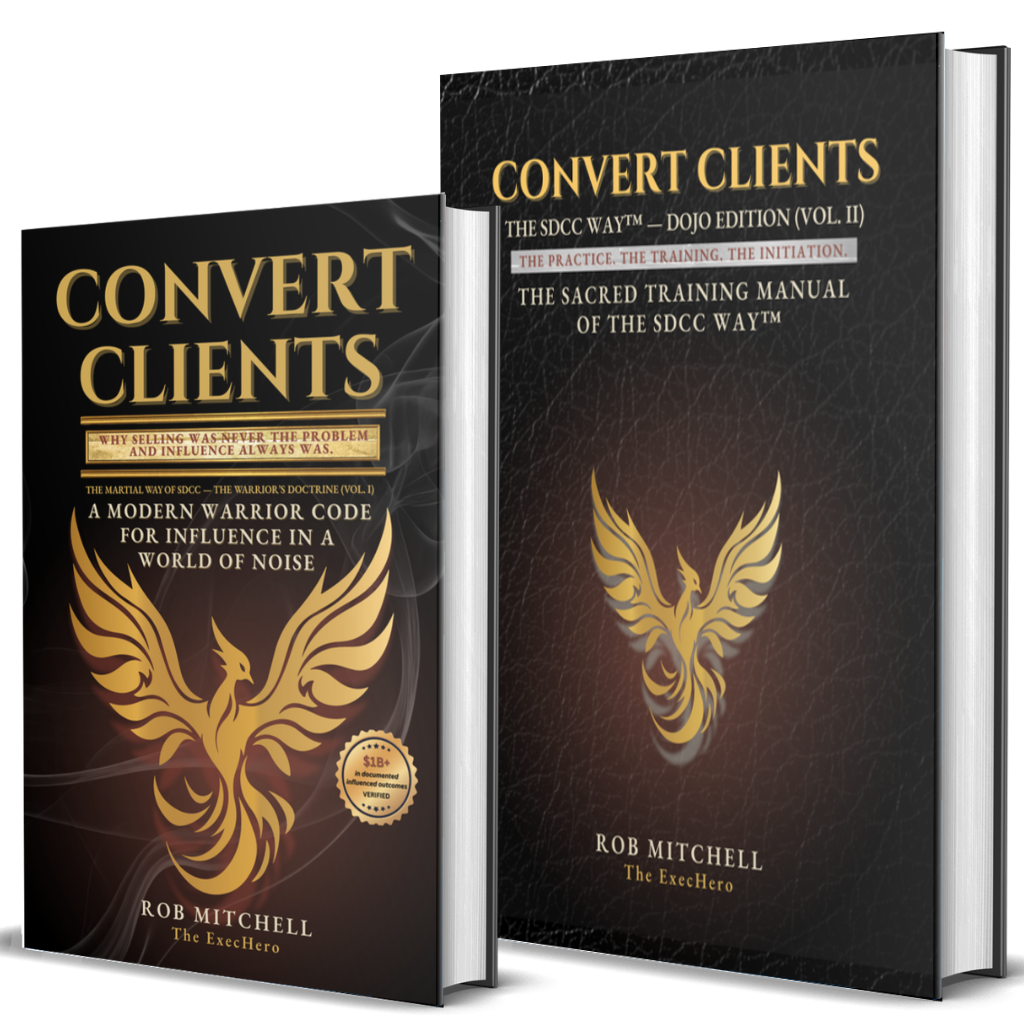
Powered by the SDCC Way™ — the decision architecture behind Convert Clients and the ExecHero Decision Leadership ecosystem.
View Convert Clients Volume I →
This isn’t about replacing people.
It’s about unleashing them.
“ARCS™ handles the chase. You handle the close.”
The best salespeople hate chasing. They should not be buried in reminders, reschedules, cold follow-up, and administrative lead handling.
Whether you sell alone or lead a team, ARCS™ moves more prospects into warmer, better-timed sales conversations with the next decision already in motion.
Salespeople are not going out of style.
ARCS™ simply handles the work that drains them.
Same Offer. Same team. Stronger System.
Every opportunity worked.
ARCS™ works the parts of the sales process that usually depend on memory, follow-up discipline, and perfect timing.
Instant First Touch
Lead comes in. ARCS™ responds through the right channel quickly, naturally, and intelligently.
Qualify & Nurture
Answers questions, detects friction, gauges readiness, and continues follow-up without fatigue.
Book the Appointment
Moves the prospect toward a calendar commitment when the decision window opens.
Close the Deal
You or your team enter the conversation when leverage is highest and the prospect is ready.
Long-Tail Follow-Up
Rebooks no-shows, follows up after calls, revives cold leads, and nurtures for up to one year.
Where revenue used to quietly slip away.
The lead who just filled out your form
ARCS™ engages while the decision window is still open instead of letting the prospect cool down or call someone else.
The prospect who asks 1,000 questions
ARCS™ absorbs questions patiently, consistently, and naturally without you or your team losing momentum or going off-script.
SMS & Phone-based scheduling
No more endless back-and-forth. ARCS™ guides the scheduling conversation and books the call for you on your calendar (sales call, service call, insurance quote, beauty appointment, and more).
After the sales call
Proposal not opened? No-show? Delayed decision? ARCS™ keeps the thread warm and the opportunity moving.
Dead leads in your database
Every business has a graveyard of old leads nobody is working. ARCS™ reactivates the list without new ad spend.
Leads that come in at night
ARCS™ does not clock out. Overnight, weekend, and holiday inquiries get intelligent engagement instead of silence.
ARCS™ is not automation.
It is Decision-Led Revenue Infrastructure.
Traditional systems manage activity. ARCS™ orchestrates decision movement.
Decision Signals
ARCS™ evaluates urgency, friction, timing, source, responsiveness, engagement behavior, and decision readiness.
Adaptive Orchestration
The system adjusts pacing, tone, channel, follow-up frequency, escalation, and booking timing automatically.
Self-Learning Execution
ARCS™ learns from replies, bookings, outcomes, and audience behavior so the infrastructure compounds over time.
Most teams work from disconnected systems.
ARCS™ operates from one command environment.
ARCS™ does not simply send messages in the background. It operates inside a unified command environment designed to give you visibility, control, calibration, performance support, and revenue movement from one place.
One environment for the entire revenue capture system.
Inside the ARCS™ Command Environment, your system calibration, lead intake, dashboards, conversations, operations guidance, and live call support live together — not scattered across disconnected tools.
Most clients rarely need to log in. Leads enter, ARCS™ engages, Aida works the conversation, the infrastructure learns, and your team shows up when the opportunity is ready.
But when visibility, leadership, or additional conversion lift matters, you can step directly into the conversation itself. Every conversation, every movement, and every opportunity path remains transparent inside the ARCS™ Command Environment.
When the person enters, the system does not disappear.
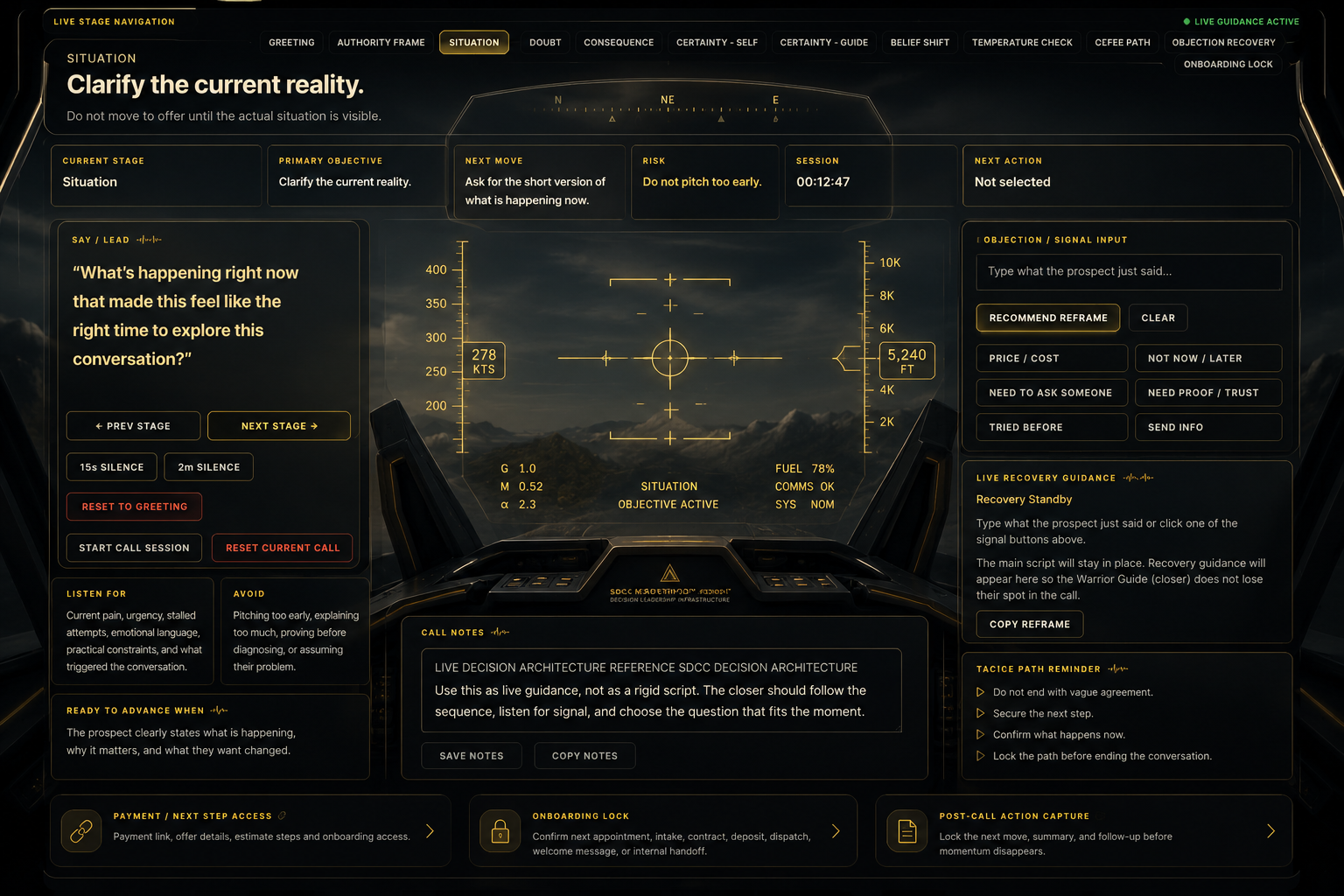
The Live Call Command HUD™ was built like a fighter jet cockpit for high-stakes sales conversations: everything critical stays within one visual field so the closer does not lose the decision path under pressure.
Stage guidance, objection recovery, tactical silence, payment access, close-path reminders, call notes, next-step capture, and SDCC tactical resources stay close — without forcing the closer to juggle scripts, notes, links, tabs, or rely on memory.
ARCS™ handles the chase. The HUD helps protect the close.
ARCS™ Intelligence Layer
Works above your CRM, calendar, dispatch, quoting, booking, or pipeline systems.
Modernizes revenue capture without forcing you to rebuild your operation.
Live Call Command HUD™ Seat
Keeps stage guidance, objection recovery, silence control, payment access, and next steps in one field of view.
Helps the person on the call protect momentum and close with more consistency.
Digital ExecHero™ Seat
Provides signal interpretation, post-call reflection, decision-stage review, and Call Doctor™ analysis — on demand.
Improves pattern recognition instead of just reviewing scripts.
On-Demand SDCC™ Influence Training Seat
Teaches the SDCC™ Way — Subconscious-Driven, Conscious Closing™, Biological Influence, and Decision Leadership principles used to guide high-stakes decisions across 100+ industries.
Aligns your people with the same decision architecture powering ARCS™.
One operational environment.
Instead of stacking separate software, automation, AI tools, dashboards, scripts, training, and manual call review,
ARCS™ brings revenue orchestration, live execution support, and operator development into one connected environment.
Hire setters, add additional staff, or buy another automation tool.
Rapid Intercept Layer™ + Aida engagement.
Add workflows, reminders, or manual task lists.
Revenue Continuity Layer™ works follow-up automatically.
Use scripts, docs, manager messages, and memory.
Live Call Command HUD™ keeps the next move in view.
Buy disconnected sales training or courses.
SDCC™ Subconscious-Driven, Conscious Closing™ Biological Influence and Decision Leadership training.
Review calls manually or guess what went wrong.
Digital ExecHero™ + Call Doctor™ identify missed signals and decision-stage breakdowns.
Add dashboards, reports, or another platform.
ARCS™ Command Environment centralizes revenue movement visibility.
Add another AI tool that does not understand your sales method.
Aida and ARCS™ operate through the SDCC™ decision architecture.
Operational Visibility
See conversations, dashboards, lead movement, system activity, and revenue capture behavior without wondering what the infrastructure is doing.
Human Performance Support
For phone sales, Zoom calls, in-home estimates, field quotes, insurance conversations, medical sales, and high-ticket closes — the HUD keeps the critical next move visible.
Decision Leadership Infrastructure
ARCS™ does not replace people. It modernizes the revenue environment around them so your team can focus on the moments where trust, judgment, and leadership matter most.
“Most systems automate tasks.
ARCS™ manages revenue movement.”
See your revenue gap in real time.
Adjust the numbers. Watch the gap update live. The point is not to exaggerate loss. It is to reveal what manual revenue handling may already be costing you.
This is an estimate for diagnostic purposes only. Actual results depend on offer, lead quality, response environment, sales ability, market, and implementation.
Most systems force a tradeoff between speed, scale, and personalization.
ARCS™ was architected differently.
- Rapid inbound interception
- AI conversational continuity
- Deep decision intelligence
- Adaptive escalation architecture
- Long-tail nurture for up to one year
Speed no longer requires sacrificing sophistication.
ARCS™ can respond instantly during high-certainty decision windows while deeper intelligence layers continue optimizing routing, escalation, personalization, and nurture in parallel.
Most systems break as scale increases. ARCS™ was designed to preserve quality, timing, and decision orchestration as lead flow expands.
Most automation systems fail silently.
ARCS was engineered to recover intelligently.
ARCS™ was engineered with Self-Healing & Regeneration Infrastructure designed to detect operational interruptions, restore communication continuity, and regenerate missing orchestration automatically — Before anyone ever realizes an interruption occurred.
Traditional automation breaks.
Most systems rely on fragile workflows, disconnected triggers, manual oversight, and static execution paths. When something fails, the breakdown often goes unnoticed until revenue is already lost.
ARCS monitors orchestration integrity.
ARCS continuously evaluates communication continuity, orchestration flow, processing states, and operational execution across the revenue capture system.
ARCS adapts, regenerates, and continues operating.
Instead of silently stopping, the system was engineered to intelligently recover, restore workflow continuity, and maintain revenue capture momentum automatically.
The future of AI infrastructure is not just automation.
It is resilient adaptive orchestration.
Most systems automate tasks.
ARCS orchestrates decisions.
ARCS operates through layered adaptive infrastructure engineered to capture, route, nurture, and advance revenue opportunities dynamically based on real-world decision behavior.
Rapid Intercept Layer™
Built for speed-to-lead engagement, immediate response timing, inbound capture, and high-intent conversational momentum.
Signal Intelligence Layer™
Maps 100+ proprietary behavioral and decision signals to identify buying patterns, urgency, engagement probability, and opportunity quality.
Deep Intelligence Layer™
Performs enrichment, contextual analysis, personalization generation, and adaptive communication orchestration across channels.
Decision Routing Layer™
Routes prospects dynamically according to SDCC™ decision-stage analysis, behavioral readiness, urgency, and communication probability.
Behavioral Orchestration Layer™
Adjusts pacing, messaging density, tone, follow-up cadence, channel selection, and communication timing automatically.
Revenue Continuity Layer™
Maintains long-tail nurture, reactivation, continuation, and follow-up continuity across the customer journey automatically.
Recovery Layer™
Revives overlooked conversations, stalled opportunities, missed follow-up, and disengaged prospects before revenue disappears.
Self-Healing & Regeneration Layer™
Detects operational interruptions, restores orchestration continuity, regenerates missing communication assets, and maintains system stability automatically.
Traditional systems manage contacts.
ARCS manages revenue movement.
We don’t optimize leads. We engineer decisions.
Most systems collect leads and send messages. ARCS™ evaluates context, behavioral signals, decision-stage readiness, timing, channel fit, and conversion friction.
- 100+ proprietary decision signals
- SDCC decision-stage mapping
- Adaptive pacing, pressure, and tone
- SMS, voice, email, LinkedIn, and social orchestration
- Self-learning revenue intelligence
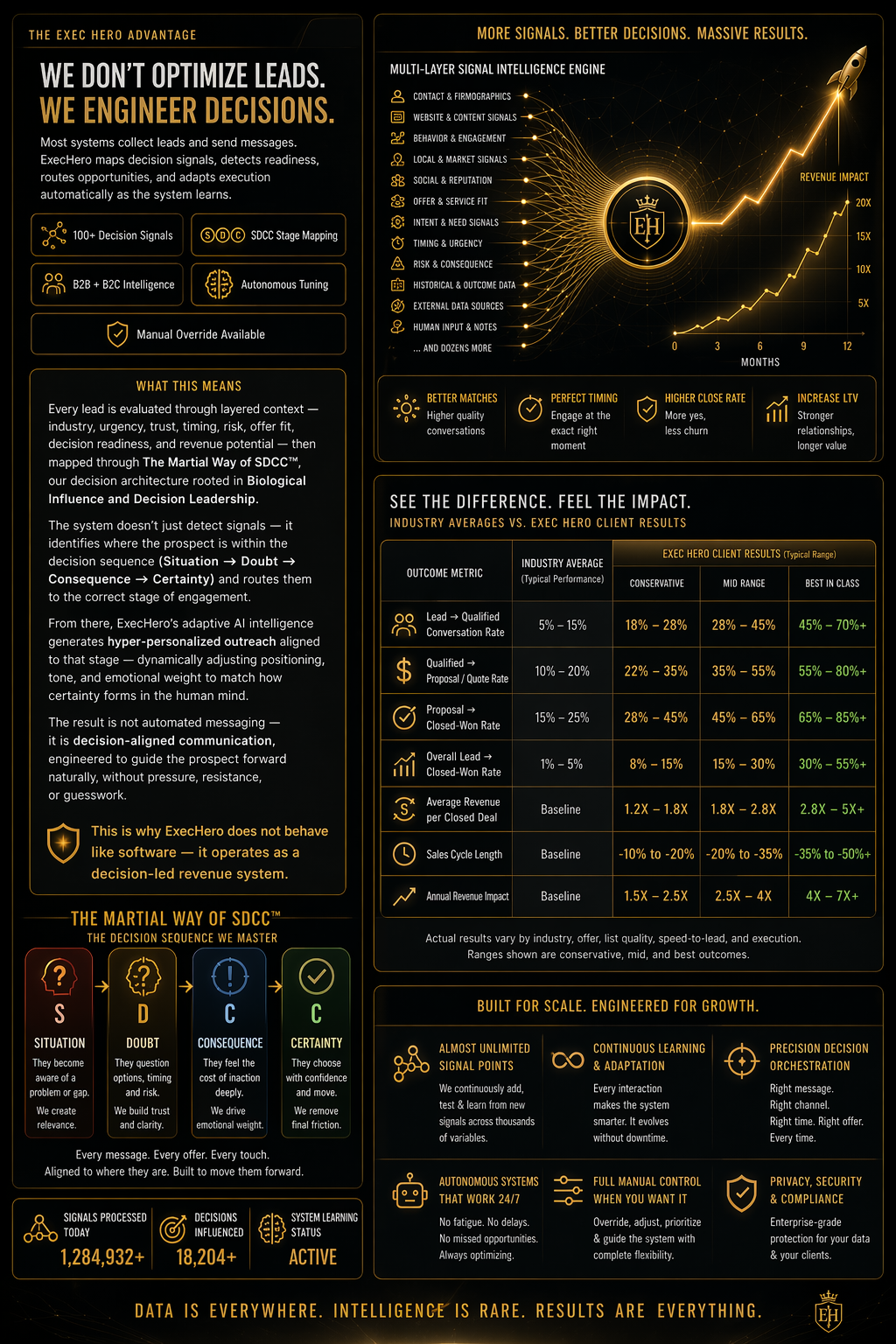
Signal Layers
Context, intent, trust, timing, friction, urgency, offer fit, and response behavior.
System Effect
Cleaner routing, natural outreach, better timing, and stronger booking movement.
Watch Aida handle an inbound call
and MOVE the prospect toward booking.
Aida is the Adaptive SDCC-Trained AI Intelligence inside ARCS™ — built to answer, engage, qualify, and guide inbound conversations without sounding like a generic bot.
Watch a text conversation move from interest to booking.
ARCS™ responds naturally, qualifies intelligently, adjusts pressure, and advances the conversation when the prospect is ready.
Four ways to deploy ARCS™ with minimal operational risk.
Start where the ROI is obvious, the risk is low, and the current process is already breaking.
After-Hours Coverage
ARCS™ covers evenings, weekends, and holidays. Nobody on your team is working those hours anyway. Pure upside.
Dead Lead Reactivation
Run ARCS™ on cold leads. Nobody is working them. Every booking is revenue you already wrote off.
Speed-to-Lead
If you are paying for leads and responding late, you are burning spend. ARCS™ handles instant first contact.
Overflow Handling
When capacity is maxed out, ARCS™ catches the overflow and keeps prospects warm until you or your team are available.
ARCS™ vs. the old way.
ARCS doesn’t force you to rebuild your business.
It strengthens the one you already have.
ARCS operates as the intelligence layer governing your revenue capture infrastructure — while allowing you to keep the systems, workflows, phone numbers, and operational structure already running your business.
ARCS integrates into your operation rather than forcing you to rebuild it.
For many businesses, this becomes one of the biggest advantages of the model:
- Keep your existing software stack
- Keep your public business number
- Keep your dispatching and scheduling systems
- Keep your existing workflows and operational processes
- Deploy ARCS gradually or aggressively depending on comfort level
For some businesses…
ARCS reduces staffing pressure, automates repetitive lead handling, and creates operational leverage without sacrificing responsiveness.
For others…
ARCS works alongside existing staff, dispatchers, CSRs, salespeople, agents, or operators — allowing humans to focus on higher-value conversations.
Either way…
ARCS can operate inside your existing booking infrastructure or support fully integrated scheduling environments depending on your operational needs.
ARCS adapts to your business just as it adapts its outreach, timing, communication style, and conversations to your prospects.
Built for organizations where
opportunities matter.
And where
missed opportunities are expensive.
ARCS™ is designed for organizations that rely on conversations, appointments, referrals, lead generation, and follow-up to drive growth. The more opportunities flowing through your business, the greater the impact of ensuring none are lost due to delayed response, inconsistent follow-up, or limited visibility.
Lead-Driven Organizations
Built for organizations where speed, follow-up, visibility, and conversion directly impact growth.
- Home services including HVAC, plumbing, roofing, and restoration
- Healthcare practices, medical groups, and specialty clinics
- Chiropractic, naturopathic, functional, and alternative healthcare providers
- Med spas, aesthetic practices, plastic surgery, and wellness centers
- Insurance agencies, brokers, and financial service professionals
- Real estate organizations, teams, and independent agents
- Independent pharmacies and patient-driven healthcare businesses
If opportunities arrive through appointments, inquiries, referrals, or lead generation, ARCS™ helps ensure they do not quietly disappear.
Relationship-Driven Professionals
Designed for professionals and teams where conversations influence outcomes and follow-through drives revenue.
- Coaches, consultants, advisors, and subject matter experts
- High-ticket service providers and premium client organizations
- Sales teams, SDR organizations, and appointment-setting teams
- Independent sales professionals and producer-driven businesses
- Medical sales, pharmaceutical, and medical device professionals
- Agencies and appointment-driven service organizations
- Founder-led and owner-operated growth companies
When revenue depends on conversations, consistency, and relationship continuity, ARCS™ helps ensure opportunities stay engaged long after most follow-up stops.
Operational Fit
ARCS™ delivers the greatest impact where opportunities are being generated but follow-up, speed, consistency, or visibility create bottlenecks.
- Paid advertising and lead generation campaigns
- SDR and setter teams booking consultations, estimates, and discovery calls
- Inbound inquiries requiring rapid response and nurture
- Outbound prospecting and business development initiatives
- Database reactivation and dormant opportunity recovery
- Referral programs and relationship-driven growth channels
- Follow-up bottlenecks, pipeline leakage, and stalled opportunities
- Speed-to-lead challenges and inconsistent engagement processes
The more opportunities flowing through the business, the greater the impact of ensuring every one receives the attention it deserves.
ARCS™ is not a standalone tool.
It is the Intelligence Layer Power-Up Add-On
for the ExecHero™ Decision Performance Infrastructure™.
Most software gives you another dashboard. We chose a different path. Instead of creating another disconnected tool, we built an ecosystem where every layer works together.
ARCS Edition™
Your autonomous revenue capture infrastructure. While your team is serving clients, ARCS™ is quietly working opportunities, recovering lost revenue, and keeping conversations moving forward.
- Engages warm, cold, and inactive opportunities automatically
- Recovers prospects that would normally disappear forever
- Reactivates old databases already sitting inside your business
- Handles follow-up, nurture, and appointment setting at scale
- Captures revenue opportunities long after most teams give up
Stop relying on memory, sticky notes, and good intentions. ARCS™ keeps opportunities moving even when your team is busy doing what they do best.
Live Call HUD™
A live decision cockpit for high-stakes conversations. Everything you need. One screen. One eye line. One place.
- Know exactly where you are in the decision journey
- Identify signals, hesitation, and buying barriers in real time
- Access objections, reframes, notes, and frameworks instantly
- Eliminate frantic searching during critical moments
- Guide conversations with greater confidence and precision
No hunting for payment links. No digging through notes. No guessing what to do next. Enter the HUD and focus entirely on the person in front of you.
Digital ExecHero™
Your on-demand performance advisor. Turn every conversation into a learning opportunity without waiting for a manager, coach, or review meeting.
- Upload call notes, transcripts, or recordings for analysis
- Identify missed opportunities and hidden decision signals
- Receive actionable coaching and improvement guidance
- Discover patterns impacting your performance
- Build awareness faster through immediate feedback loops
Great operators improve after the call. Elite operators improve after every call. Digital ExecHero™ helps close that gap.
Decision Forge™ & Dojo™
The training ground behind the performance. Because confidence under pressure is forged long before the conversation begins.
- Create strategic call plans and briefing documents in minutes
- Generate industry-specific questioning frameworks instantly
- Develop decision leadership through daily training drills
- Track progress, patterns, strengths, and growth areas
- Leverage Practitioner Memory™ for personalized development
Most people practice occasionally. The Dojo™ creates a system for continuous improvement so performance compounds over time instead of depending on motivation.
Most automation follows instructions.
Aida™ studies the decision.
ARCS™ is powered by Aida™ — the SDCC-trained AI Intelligence Layer™ built to help identify, profile, route, nurture, and adapt to how people actually make decisions.
100+ Proprietary Decision Signals
Aida™ evaluates behavioral decision signals to understand urgency, friction, readiness, trust, doubt, and where the opportunity may be stuck.
Psychological Decision Profiling
Instead of treating every prospect the same, Aida™ helps profile how a person is likely to build trust, gain confidence, and move toward action.
Adaptive Communication
Channel, timing, cadence, tone, pacing, message density, and follow-up strategy adapt around the person — not the other way around.
Most systems push prospects through a process.
Aida™ helps the process adapt to the prospect.
And because Aida™ learns from uploaded opportunities, replies, conversations, timing, and outcomes, the intelligence layer becomes more useful over time.
Before we discuss ARCS™, let’s first determine how much revenue, time, and opportunity may already be slipping through the cracks.
Most businesses do not have a lead generation problem.
They have a revenue capture problem.
Leads come in. Prospects show interest. Conversations begin.
Then slow response, static automation, weak follow-up, no-shows,
staff overload, and missed timing quietly drain the opportunity.
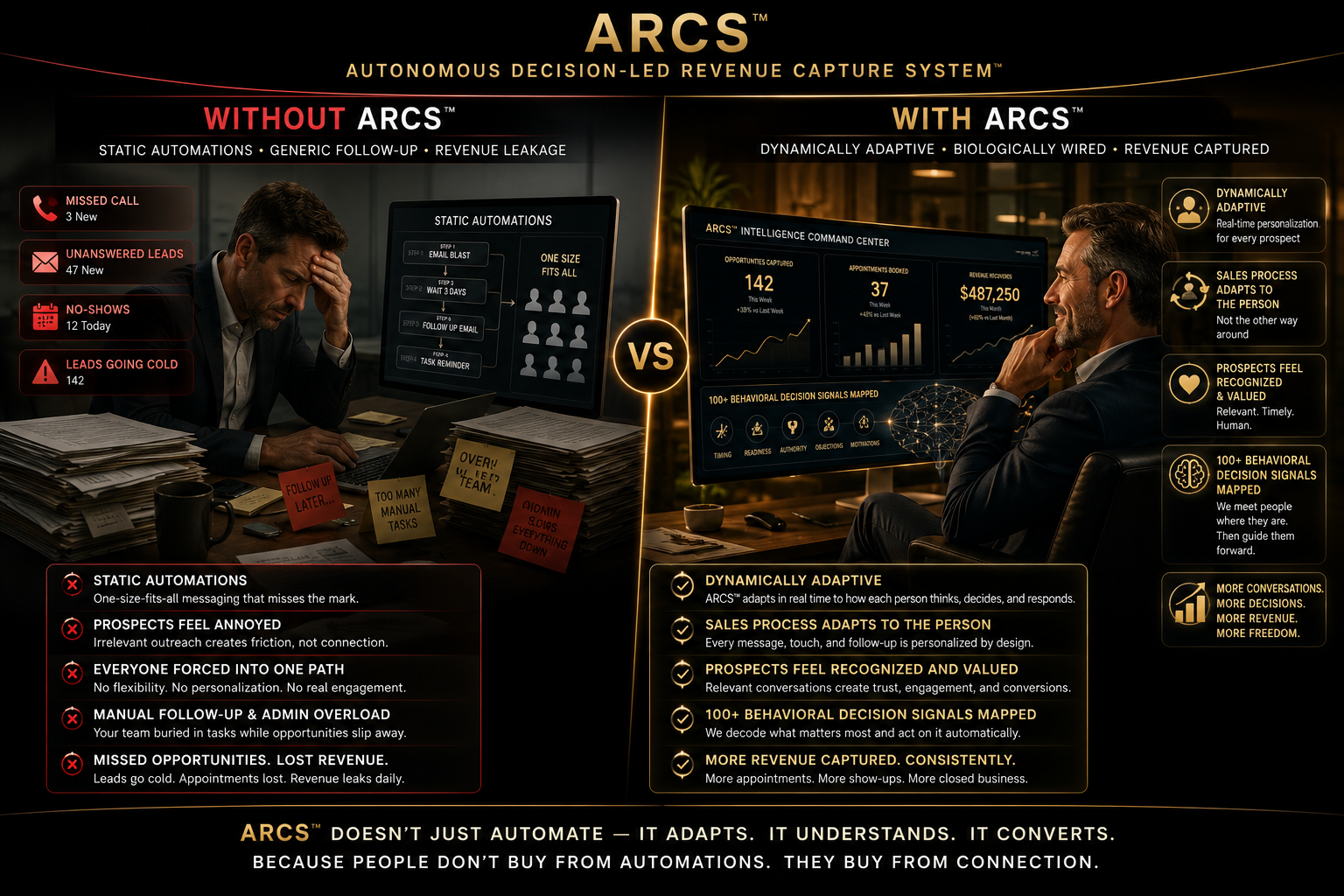
ARCS™ does not simply automate follow-up.
It adapts the revenue capture process to how each person naturally thinks, decides, responds, and moves forward.
Find The Revenue Leak
We look for the places where opportunities are cooling down, no-shows are not being recovered,
old leads are sitting untouched, or prospects are being forced through generic follow-up paths.
Recover Team Capacity
We identify where talented people are spending time on low-leverage work — texting, chasing,
rescheduling, answering the same questions, and manually nudging prospects who should already be moving.
Map The Capture Opportunity
We determine whether ARCS™ can help increase speed-to-lead, improve follow-up consistency,
revive old opportunities, reduce staff burden, and move more qualified prospects into sales conversations.
Book An ARCS™ Strategic Assessment
This is not a casual software walkthrough.
It is a focused revenue capture assessment for serious operators who want to understand
where revenue may be leaking, where people are being underutilized, and whether ARCS™ is
the right infrastructure to help close the gap.
Reserved For Operators Who Are Serious About Revenue Capture
- Business owners generating leads or opportunities
- Practice owners with follow-up, no-show, or reactivation gaps
- Sales leaders tired of inconsistent lead handling
- Teams whose best people are buried in repetitive follow-up
- Organizations ready to move beyond static automation
This Is Not For Tire Kickers
- Businesses not currently creating demand
- Operators only looking for free consulting
- Teams unwilling to improve follow-up discipline
- Anyone wanting generic automation instead of adaptive infrastructure
- Organizations not ready to invest in revenue capture
“The question is not whether follow-up is happening. The question is whether the right message is reaching the right person at the right moment in the way they are most likely to respond.”
Founder pricing is currently available for qualified early adopters. Organizations that activate during the founder phase retain their pricing permanently, even as ARCS™ continues to evolve and additional capabilities are added.
You do not need another tool to manage leads.
You need infrastructure that captures revenue from the demand you already create.
Generate Demand.
Capture Revenue.
Scale Freedom.