It changes where we look.
Instead of beginning with results that have already become history, Decision Science begins
with the decisions still capable
of changing the future.

Before revenue becomes visible.
Before culture takes shape.
Before strategy succeeds or fails.
Before an organization becomes what it will become—
decisions have already begun creating the outcome.
Decision Science™ is the discipline devoted to understanding how decisions become outcomes across individuals, organizations, and society through the observation, study, design, and continual improvement of decision systems.
“What if the most important thing an organization produces is not its products— but its decisions?”
Change where you look, and the organization begins to reveal itself differently.
Those decisions—deliberate and habitual, visible and invisible—accumulate across time until they become the results organizations eventually measure.
Departments, processes, technologies, products, policies, budgets, and reports are visible. Beneath them exists another organization—made of assumptions, interpretation, judgment, conversations, decisions, learning, memory, and trust.
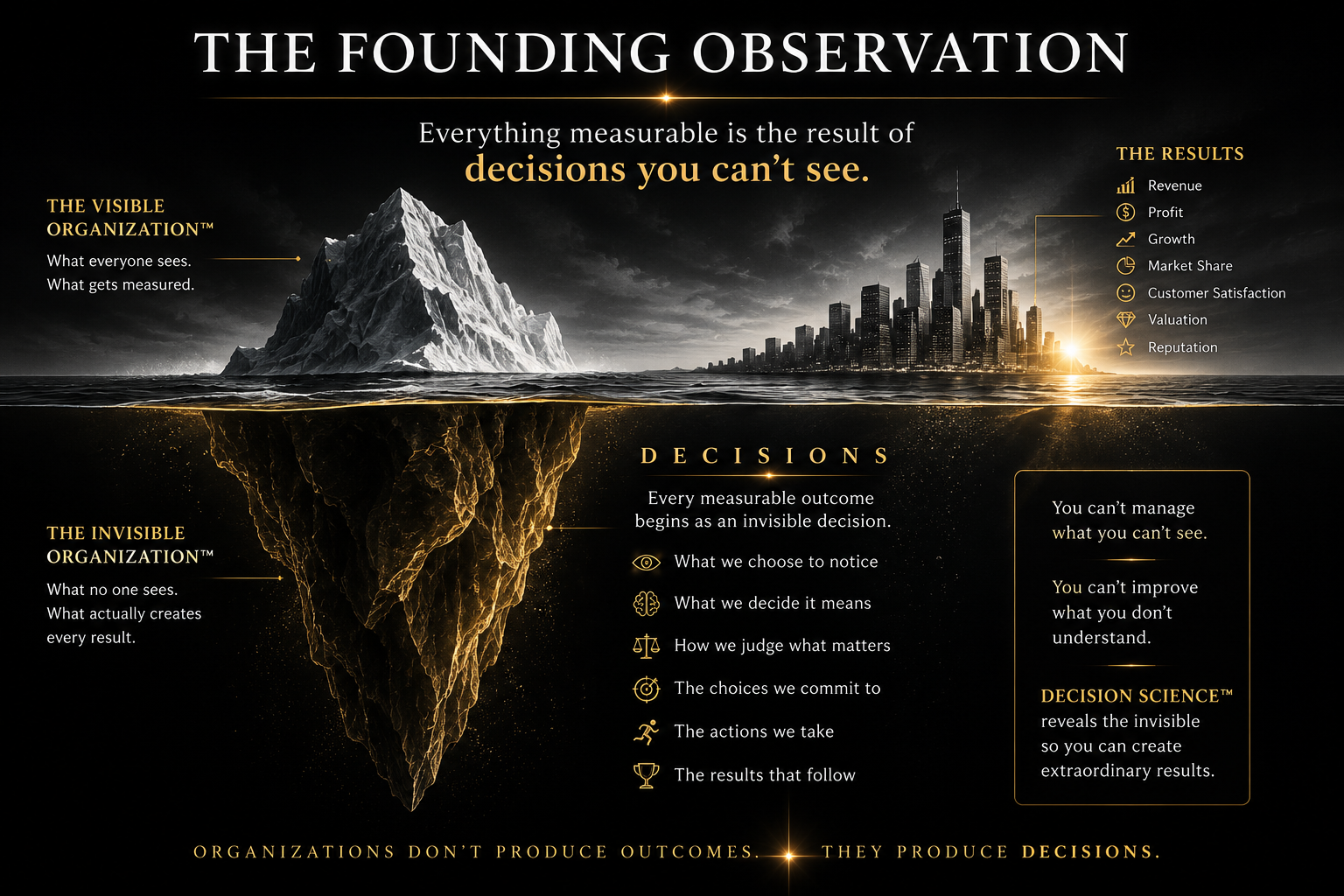
Revenue. Profit. Growth. Retention. Culture. Innovation. Customer experience. Patient outcomes. Enterprise value.
Every one matters.
But they share one limitation:
they describe what has already happened.
By the time an outcome becomes visible, the decisions that created it have already been made.
It asks not only, “What happened?” but:
“What decisions quietly created this—
and what decision system produced them?”
It is not a replacement for leadership, psychology, economics, management, medicine,
technology, or systems thinking. Each of those disciplines encounters decisions.
Decision Science studies them.
Decision Science™ is the discipline devoted to understanding how decisions become outcomes across individuals, organizations, and society through the observation, study, design, and continual improvement of decision systems.
Instead of beginning with results that have already become history, Decision Science begins
with the decisions still capable
of changing the future.
Leadership, psychology, economics, management, technology, medicine, and systems thinking all encounter decisions. Decision Science studies the common architecture beneath them.
Clearer observation improves judgment. Better judgment improves decisions. Better decisions improve the probability of better outcomes.
What appears to be one choice is often the visible conclusion
of an invisible process
that began much earlier.
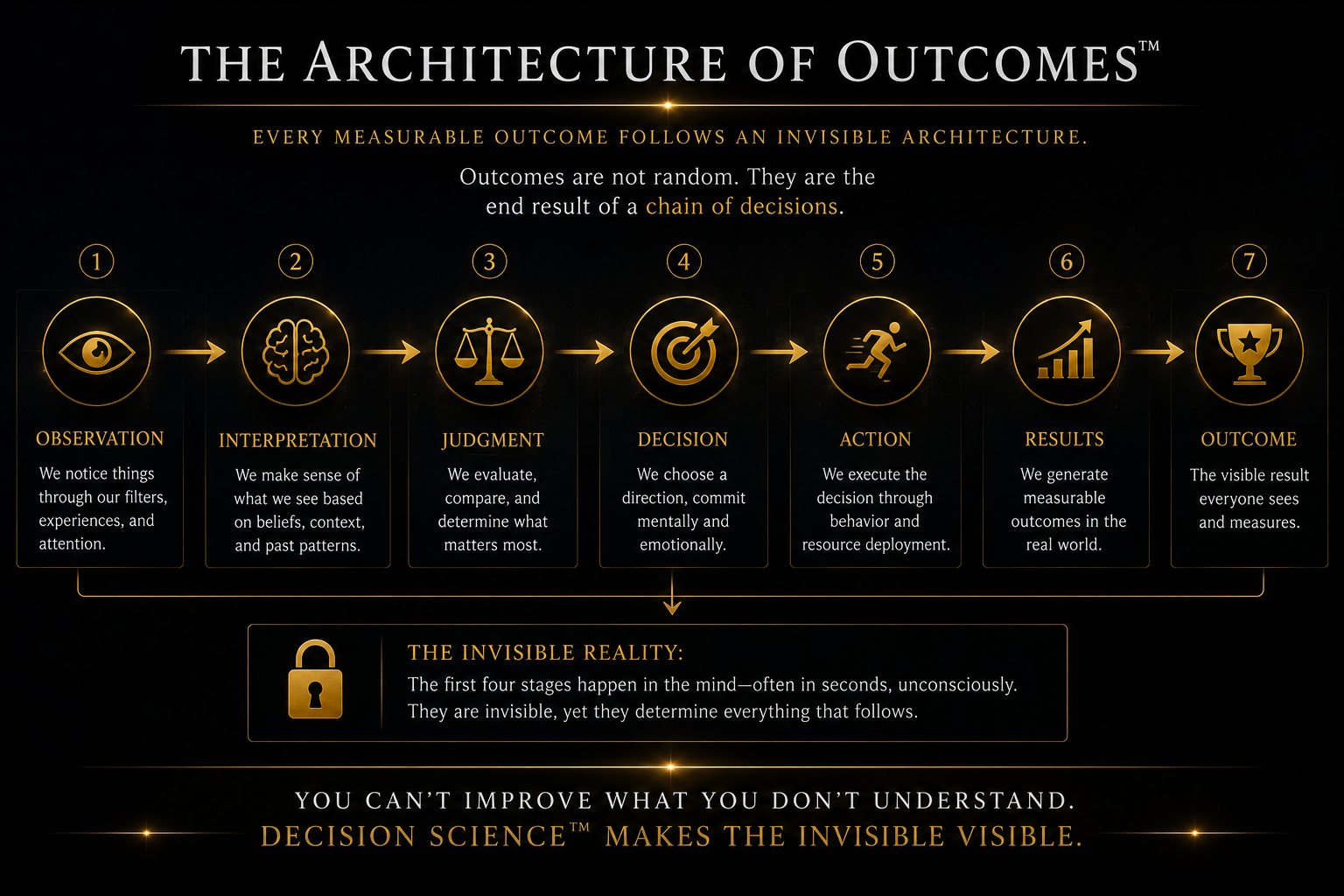
A Decision System™ is the interconnected collection of observations, interpretations, judgments, processes, structures, technologies, behaviors, relationships, and feedback loops through which decisions are consistently produced.
The organization is the visible expression. The decision system is the invisible process through which the organization continually interprets reality and transforms judgment into action.
Once that distinction becomes visible, the question changes from:
“What should we do?” to:
“What kind of decision system would naturally produce
the future we hope to create?”
Beneath every familiar measure of organizational performance
lies another capability
that is rarely observed directly:
the performance of the system that continuously produces decisions.
“Organizations are ultimately limited not by the quality of their intentions, but by the quality of the decisions they repeatedly produce.”
Decision Performance™ is the capability of a decision system to consistently transform observation into sound judgment, sound judgment into effective decisions, and effective decisions into meaningful outcomes over time.
Revenue, growth, quality, retention, efficiency, culture, customer outcomes, patient outcomes, enterprise value.
It describes what has happened.
Observation, judgment, learning, adaptation, decision quality, execution, preserved memory, and the health of the system connecting them.
It helps explain the source.
Decision Performance is not organizational success.
It is organizational capability.
Capability creates probability.
Probability influences outcomes.
Outcomes confirm capability only over time.
Traditional metrics are essential—but predominantly lagging. Decision Science adds a leading lens by observing the conditions that shape what those metrics may become.
Every mature discipline develops instruments that help reveal what ordinary observation cannot. Decision Science requires an instrument for observing the health of the decision system itself.
The Decision Performance Index™ is a structured observational framework within Decision Science™ designed to evaluate the health, maturity, and effectiveness of an organization's Decision Performance™ by examining the quality of the decision systems from which future outcomes emerge.
The Index produces a Decision Performance Score™ from 0 to 1000. The value is not the number itself. The value is what the number reveals about the system underneath it.
The Decision Performance Index™ does not measure success. It measures the conditions from which success becomes more—or less—likely.
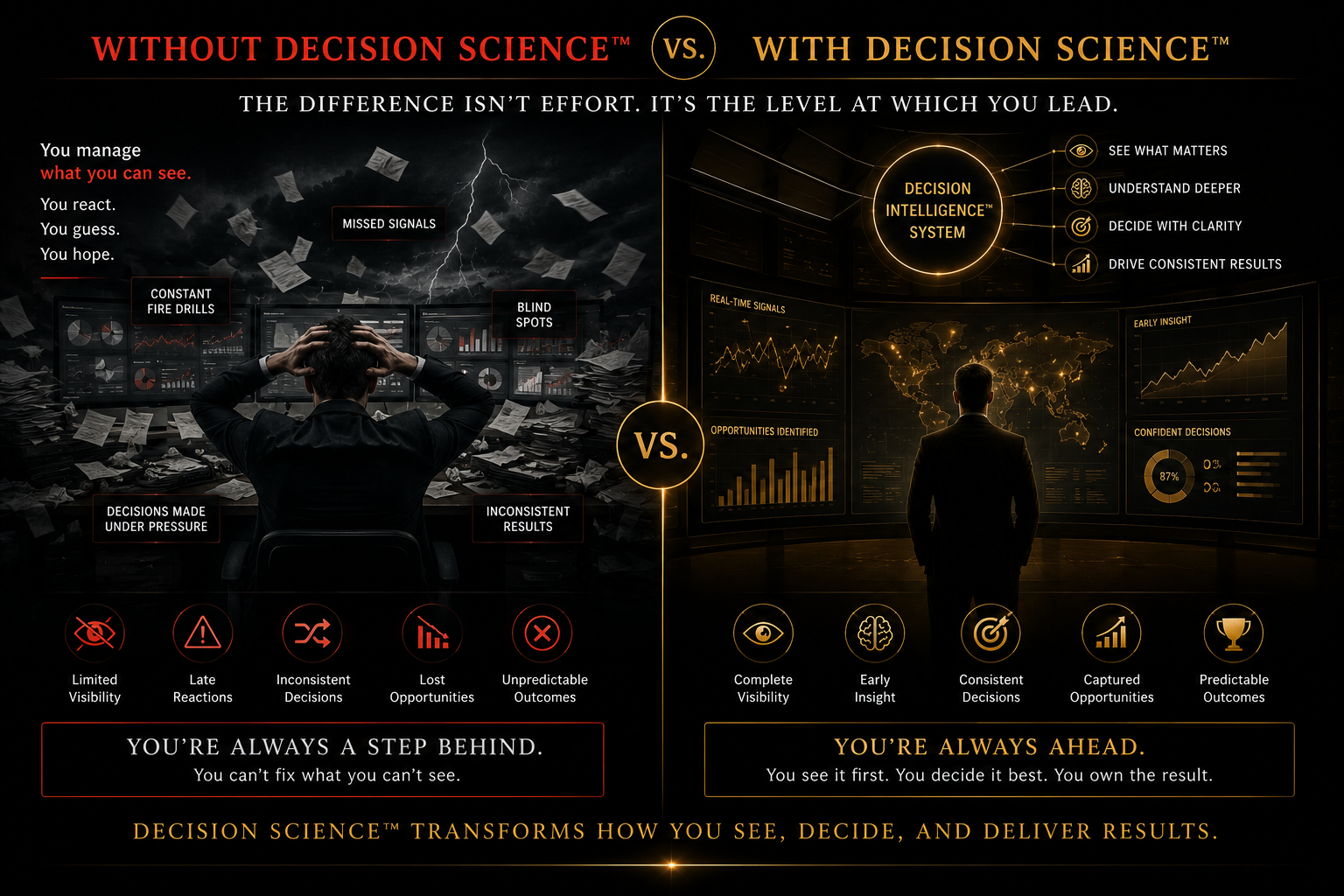
Managing symptoms keeps leaders behind the outcome.
Decision Science moves observation earlier—while judgment, decisions,
and the future they create can still be influenced.
Decision Science™ provides the broad lens for understanding how decisions become outcomes. From that foundation, specialized disciplines and operating systems can address different decision environments.
Studies how decisions become outcomes across individuals, organizations, and society.
Studies individual decision formation and principled influence—how biology, identity, emotion, trust, consequence, and conscious reasoning shape movement.
Focuses on the quality, consistency, and effectiveness of the decision capability operating within individuals, teams, commercial environments, and organizations.
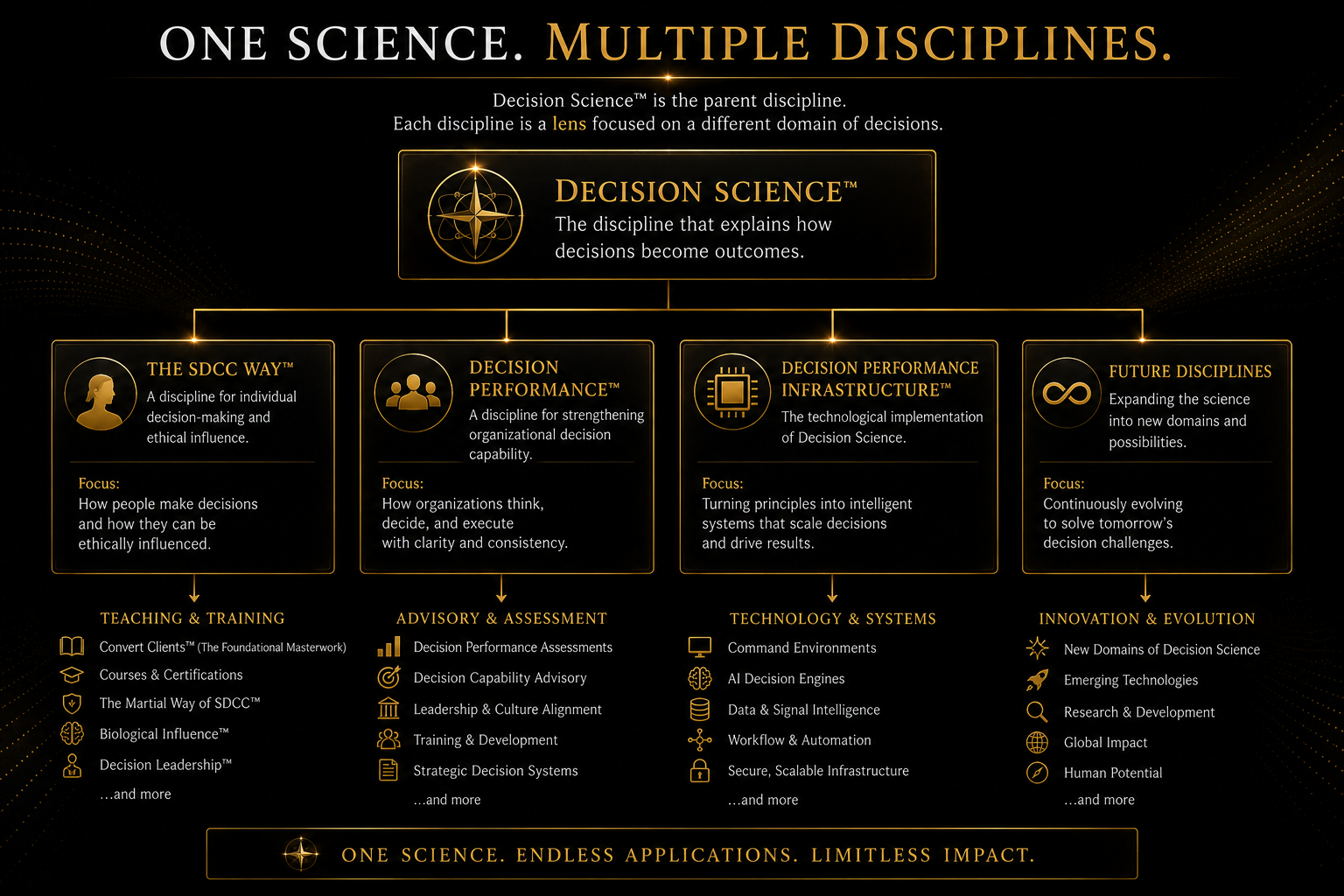
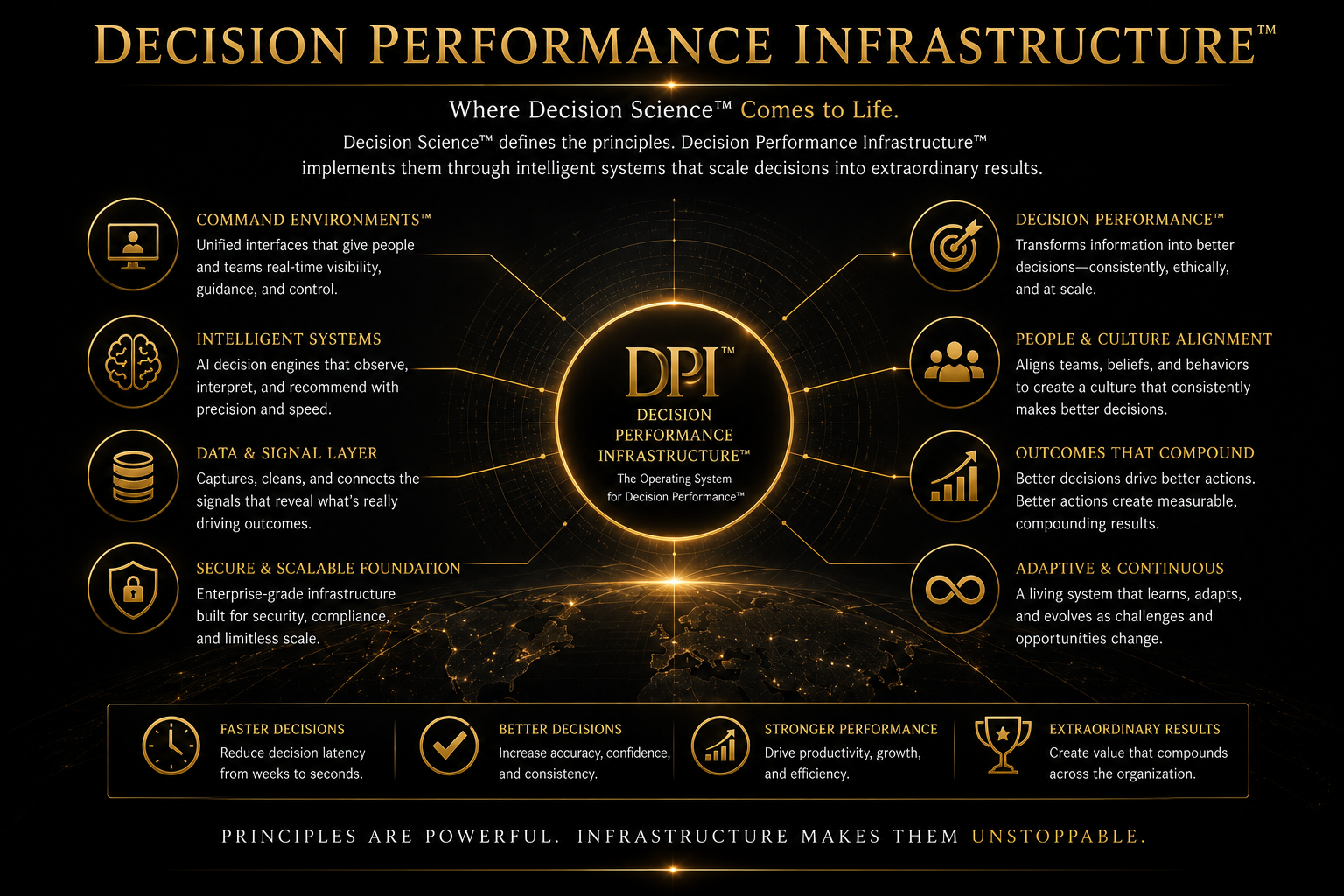
Decision Performance Infrastructure™ is the intentionally designed operating environment
that helps individuals and organizations make better decisions—
and turn those decisions into measurable performance.
That can mean increasing revenue.
Converting more clients.
Closing high-value opportunities faster.
Finding and repairing the leaks where money, momentum, clients, and opportunities are being lost.
Improving execution.
Strengthening leaders and teams.
And making high-quality performance more consistent—
instead of dependent on a few exceptional people having an exceptional day.
Beneath those outcomes is the infrastructure that makes them increasingly repeatable:
stronger observation,
better judgment,
greater Decision Capacity™,
preserved Organizational Memory™,
reduced Decision Drag™,
and decision systems that continually learn and improve.
Decision Science™ defines the principles.
Decision Performance™ defines the capability.
Decision Performance Infrastructure™ makes that capability operational—
so better decisions can become better outcomes.
Decision Science™: A New Way of Seeing Organizations — Vol. I
begins with a deceptively simple question:
What if the most important thing an organization produces
isn't its products—
but its decisions?
Follow that question far enough and the organization begins
to look different.
Revenue. Growth. Culture. Execution. Client conversion.
Innovation. Retention. Enterprise value.
These are the outcomes we see.
The book takes you beneath them—
into the invisible decision systems quietly creating them.
You'll discover the Invisible Organization,
the Architecture of Outcomes™, Decision Systems™,
Decision Performance™, Decision Drag™,
Decision Capacity™, Organizational Memory™,
Decision Debt™, the Decision Performance Index™—
and an entirely different way of seeing
where tomorrow's performance is actually being created.
Because once you learn to see decisions before they become outcomes,
you no longer have to wait for the scoreboard
to tell you what happened.
Once outcomes are understood as the visible expression of decisions,
the work moves upstream—
to observation,
judgment,
decision systems,
and the conditions from which
tomorrow's performance is already emerging.